

Education in a Changing World
A guided account of postwar educational change, from expanding rights and challenging discrimination to nation-building, international initiatives, and the continuing distinction between access and equity.
Rights, , and the limits of law
Education becomes a public concern
After the Second World War, schooling became a central concern of governments and international organizations. The 1948 Universal Declaration of Human Rights described education as a right. At the same time, civil-rights struggles and the end of colonial rule reshaped who schools served and who controlled them.
These changes widened attention to education, but wider did not automatically create equal opportunity. Educational systems continued to reflect social and economic inequalities. It is therefore important to distinguish between recognizing a right or opening a route into school and ensuring that people receive fair treatment and meaningful chances to learn.
Legal challenges—and their limits
In the United States, the Supreme Court ruled in 1954 in that racial segregation in public schools violated the Constitution’s guarantee of equal protection. A 1955 follow-up directed school authorities to desegregate. Implementation met sustained resistance and proceeded unevenly, but the case became a landmark in challenging racial barriers in education.
Internationally, UNESCO’s 1960 Convention against Discrimination in Education called on states to oppose exclusion and unequal treatment based on characteristics including race, sex, language, and social origin. Together, these examples show how legal measures could challenge discrimination and establish important commitments.
However, a legal commitment is not the same as an equal educational experience. Laws alone could not ensure equal school resources or outcomes. The key distinction is between changing formal rules and overcoming the wider inequalities that shape what educational opportunities people actually receive.
Education and after decolonization
Building national education systems
As colonies gained independence—especially during the rapid wave of decolonization in Asia and Africa after 1945—new governments faced the task of building national education systems. Expanding public schooling could serve several connected aims: developing literacy, training workers and public servants, and supporting a shared national identity.
But building a system did not mean starting from nothing. Many new systems retained colonial-era structures, including languages of instruction, examinations, or curricula. Governments and educators had to weigh which inherited institutions to keep and how to make education reflect local histories, languages, and priorities.
This was a choice about both continuity and change: existing structures could remain, while the content and organization of education could also be reconsidered in light of local needs. The source describes this as an ongoing challenge, rather than suggesting that newly independent countries all made the same choices or completed the task in the same way.
International commitments to education
Shared international priorities
International cooperation increasingly treated education both as a human right and as a foundation for development. UNESCO’s 1960 convention against discrimination set out a framework for equal treatment. In 1990, governments and international agencies launched the initiative at a conference in Jomtien, Thailand. Its vision included basic education for children, young people, and adults, with attention to learning needs and .
In 2000, the Dakar World Education Forum renewed the commitment and established goals for progress by 2015. Across these initiatives, , gender equality, and learning quality became shared international priorities.
The sequence shows how international commitments developed: first, education was framed as a right and as important to development; then EFA set out a broad vision for basic education; and Dakar renewed the commitment with goals. These agreements helped define common aims, but a shared target is not proof that it was achieved. The commitments did not guarantee that every goal would be met.
Higher education: expansion and
More routes into advanced study
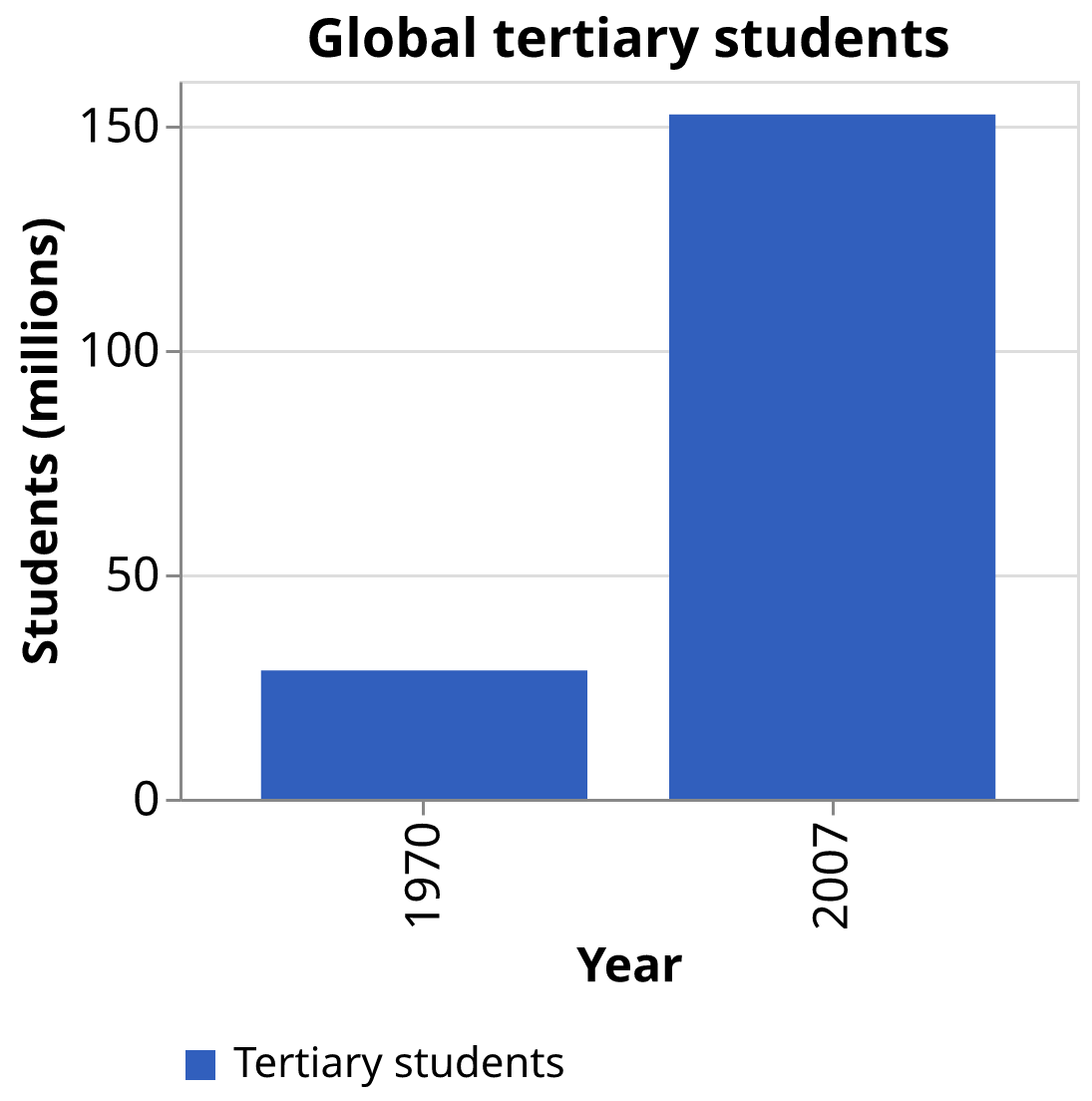
Demand for professional skills, scientific knowledge, and social mobility led countries to expand universities and create or enlarge other postsecondary institutions. The global number of tertiary students rose from about 28.6 million in 1970 to 152.5 million in 2007, opening new routes into advanced study.
That increase shows substantial growth in enrollment, but it does not by itself establish that opportunities became equitable. Participation still differed widely among regions and social groups. Expansion also raised questions about affordability and the roles of public and private provision.
Text description
Global tertiary students A bar chart compares global tertiary student totals, in millions: about 28.6 in 1970 and 152.5 in 2007. Tertiary students (Year; Students (millions)): 1970; 28.6 2007; 152.5
Why expansion is not the same as
means having a route into education. goes further: it also requires fair treatment and meaningful opportunities to learn and succeed. So, an increase in places or enrollment can broaden without ensuring that students have equally fair opportunities.
This distinction helps interpret higher-education expansion. More people could enter advanced study, yet uneven participation and questions of affordability remained. The growth of universities and other institutions therefore opened routes while leaving an important question unresolved: whether expanded enrollment would also bring more equitable opportunities.