

Food Supply Chains and Food Systems
A lesson on tracing food from production to consumption and understanding the wider connections, supports, outcomes, and feedback that shape food systems.
Tracing a
What a supply chain traces
A is the connected sequence of activities and actors that moves food from production toward consumption. It is a way to trace where food goes and what happens to it along the way—not a claim that every product follows exactly the same route.
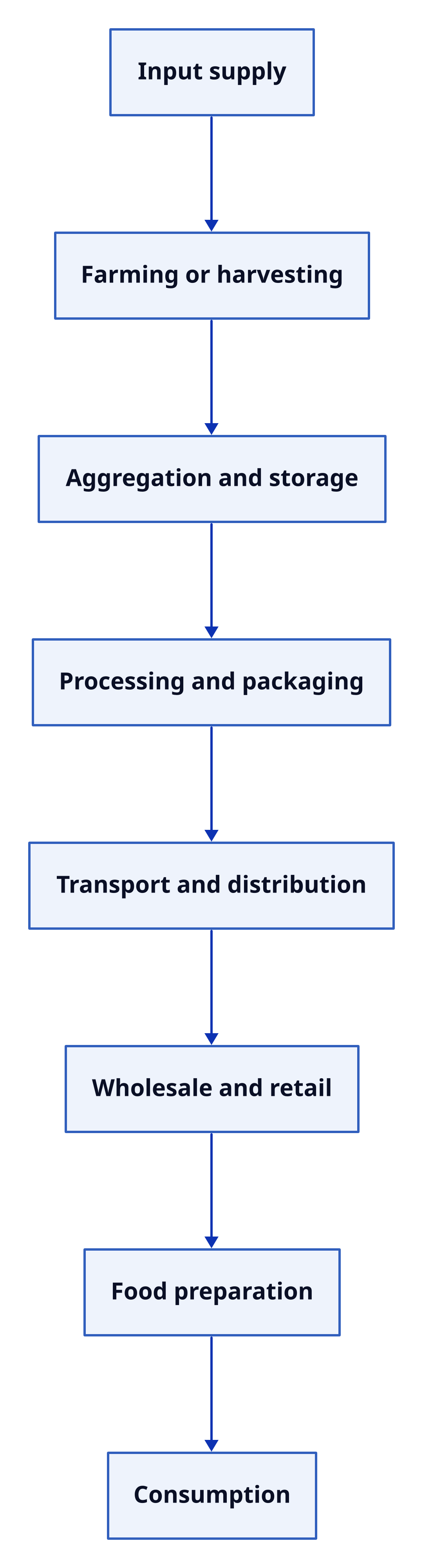
A common route runs from farm inputs and production through aggregation and storage, processing and packaging, transport and distribution, wholesale and retail, food preparation, and consumption. The particular actors vary: farmers, warehouses, processors, distributors, shops, restaurants, and households may all be involved. Some frameworks also include what happens to .
Text description
A common route from inputs to consumers A downward flowchart shows this sequence: Input supply leads to Farming or harvesting, then Aggregation and storage, Processing and packaging, Transport and distribution, Wholesale and retail, Food preparation, and Consumption. Layout: down. Input supply Farming or harvesting Aggregation and storage Processing and packaging Transport and distribution Wholesale and retail Food preparation Consumption Input supply → Farming or harvesting Farming or harvesting → Aggregation and storage Aggregation and storage → Processing and packaging Processing and packaging → Transport and distribution Transport and distribution → Wholesale and retail Wholesale and retail → Food preparation Food preparation → Consumption
Follow the product, not a fixed template
The stages depend on the food. Fresh vegetables may move quickly from a farm to a market. Wheat, by contrast, may be stored at an elevator, milled into flour, baked into bread, and distributed through several businesses. To trace a chain, follow the product through the activities it actually undergoes; not every product passes through every stage.
For example, the wheat-to-bread route can be traced step by step: farm inputs support wheat production and harvest; an elevator may store and combine grain; a mill makes flour; a bakery makes bread; distributors carry it to shops or restaurants; and consumers buy or eat it. can arise at any point. Some may be recovered, reused, or composted, while other material is discarded.
From Supply Chain to
Two useful views
A supply-chain view follows the food: its movement and the activities and actors involved. A food-system view includes that chain, but also asks what shapes its operation, who benefits, and what effects result.
The broader view includes people and natural resources, infrastructure and services, institutions and policies, and social and economic conditions. It also considers outcomes such as people’s livelihoods and access to food, as well as environmental effects. These are not extra steps that every food physically passes through; they are part of the context that can enable or constrain the chain and influence its outcomes.
Wheat to bread: applying both views
A chain-focused account traces seed, machinery, and fuel supporting wheat farming; harvest and elevator storage; milling grain into flour; baking bread; distribution; and sale or consumption. It emphasizes the sequence of food-handling stages.
A food-system account includes that same sequence, then widens the view. Research and agricultural extension can support production; finance can help pay for inputs; roads and fuel enable transport; and food-safety rules and inspections help protect consumers. Social and economic conditions also shape food access and livelihoods, while the system’s outcomes include environmental effects. Consumer demand influences how much bread is produced and what kinds are offered.
So, when a question asks where food moves and what activities it undergoes, trace the supply chain. When it asks what makes those activities possible, who benefits, or what impacts result, use the broader food-system view.
Interdependence, Support, and
Why stages depend on one another
A food chain is connected, not just a list of businesses. Consider a perishable crop: producing it is not enough to get it to consumers. It also depends on harvesting labor, suitable packing, timely transport, cold storage, market access, and buyers. If one of these connections fails, later stages may be affected.
For instance, a road closure or loss of refrigeration can disrupt the movement of a perishable crop. This illustrates how a problem at one point can affect what happens downstream; the exact consequences depend on the product and the chain involved. Conversely, requirements from later stages can shape earlier choices. A processor’s demand for a particular variety or grade can influence what farmers decide to grow.
Support systems and
Many services and institutions support or regulate activity across several stages rather than handling food at just one point. These include finance and insurance; research, extension, and information; utilities and roads; food-safety systems; laws and standards; and public agencies. Food distribution therefore relies not only on businesses moving or processing food, but also on services, infrastructure, and rules that help coordinate their work.
Influence also travels back through the chain. Consumer demand, prices, and purchasing choices affect what producers grow and how businesses process and distribute food. Processor demand for a variety or grade can likewise send a signal upstream to farmers. In other words, food flows toward consumers, while decisions and signals can move in both directions. This helps explain why choices at one stage may depend on expectations elsewhere in the system.