

Genetic Crosses and Offspring Predictions
A guided lesson on using allele notation, gametes, Punnett squares, and probability to predict offspring while checking the assumptions behind the predictions.
From Genotypes to Gametes
A is an organism’s allele combination at a gene; a is an observable trait influenced by and often by the environment. For a gene with two alleles, AA and aa are because their two alleles match. Aa is heterozygous because its alleles differ.
In a simple model of complete dominance, an individual with at least one dominant allele (A) shows the dominant . Only aa shows the recessive . The capital and lowercase letters are notation: capitalization does not tell you how common, strong, or beneficial an allele is.
During gamete formation, the two alleles an individual carries for a gene separate, so each gamete receives one. Thus an Aa parent can produce A or a gametes, each with equal probability.
For two genes, an AaBb parent can produce AB, Ab, aB, and ab gametes if the genes assort independently. Each type is then equally likely. This condition matters: the four equal probabilities are not assumed for every two-gene cross.
Punnett Squares and a One-Gene Cross
To build a , first write each parent’s and list the allele combinations each can place in a gamete. Put one parent’s gametes across the top and the other parent’s down the side. Combine the alleles at the row and column of each cell. Finally, count the genotypes or phenotypes requested and express the results as fractions, percentages, or ratios. Each cell is equally likely when the listed gametes are equally likely.
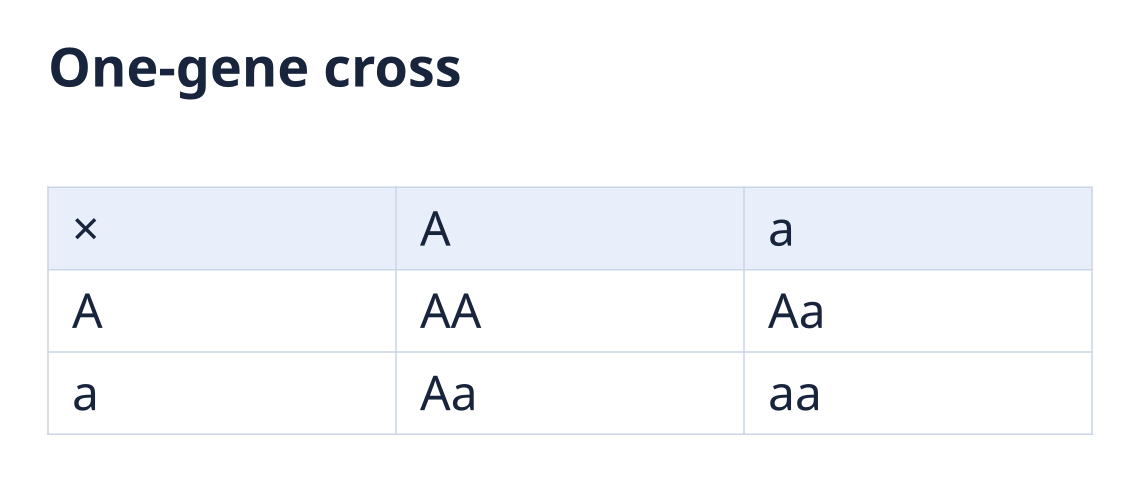
Text description
One-gene cross A two-by-two Punnett square for parents Aa and Aa. Gametes A and a appear across the top and along the side. The four offspring genotypes are AA, Aa, Aa, and aa. Aa × Aa: AA (1/4), Aa (1/4), Aa (1/4), aa (1/4). ×: A; A: AA; a: Aa ×: a; A: Aa; a: aa
For Aa × Aa, the four genotypes are AA, Aa, Aa, and aa. Counting them gives a of 1 AA : 2 Aa : 1 aa: 25% AA, 50% Aa, and 25% aa. Under complete dominance, both AA and Aa show the dominant , so the is 3 dominant : 1 recessive, or 75% to 25%. The probability of a recessive- offspring is therefore one in four for each birth under this model—not a promise that exactly one out of every four offspring will have that .
A cross can also help distinguish possible genotypes. An individual showing the dominant could be AA or Aa. Cross that individual with a recessive individual, aa:
If the unknown individual is
AA,AA × aapredicts only dominant- offspring: all areAa.If the unknown individual is
Aa,Aa × aapredicts halfAaand halfaa—equal proportions of dominant and recessive phenotypes.
This is informative because the recessive parent always contributes a; the other parent’s possible alleles determine whether recessive offspring can result.
Two Genes: Dihybrid Crosses and Probability
Consider AaBb × AaBb, where A and B are dominant alleles. If the two genes assort independently, each parent can produce four equally likely gametes: AB, Ab, aB, and ab. Combining the four gamete types from each parent gives 16 equally likely outcomes. Rather than list every cell, group those outcomes by , assuming complete dominance at both genes.
| Phenotype group | Proportion |
|---|---|
| A_B_ | 9/16 |
| A_bb | 3/16 |
| aaB_ | 3/16 |
| aabb | 1/16 |
The groups give the expected 9:3:3:1. For example, includes offspring with at least one A and at least one B; either allele at the second position of each gene pair can be dominant or recessive. The ratio requires complete dominance at both genes and independent assortment.
Probability can also find these proportions without filling in all 16 combinations. In AaBb × AaBb, the chance of aa is 1/4, and the chance of bb is 1/4. Because the gene outcomes are assumed independent, multiply to find the chance of both: 1/4 × 1/4 = 1/16 for aabb.
For A_bb, first find the chance of A_, meaning at least one A. The mutually exclusive genotypes AA and Aa have probabilities 1/4 and 1/2, so their probabilities add: 1/4 + 1/2 = 3/4. Then multiply by the independent chance of bb, 1/4: 3/4 × 1/4 = 3/16. This illustrates both rules: add probabilities for mutually exclusive alternatives, and multiply probabilities for independent outcomes.
Check the Model and Interpret Predictions
A predicts probabilities; it does not guarantee exact offspring counts. For instance, a predicted one-in-four chance of a recessive for each birth does not mean every group of four offspring will include exactly one with that . Actual results can differ by chance, especially when there are few offspring.
Also check whether the model’s assumptions fit the cross. Genes close together on the same chromosome may be inherited together more often; this linkage can alter the expected dihybrid ratio. Classic ratios may also fail when alleles do not show complete dominance or when other genetic or environmental effects influence the trait. Treat ratios such as 3:1 and 9:3:3:1 as conditional predictions, not universal outcomes.
: A cross that tracks two genes at once.
: A probability-based estimate of possible offspring genotypes or phenotypes.