

Integrated Financial Reporting Review
A practical framework for checking support, accuracy, classification, consistency, and completeness across a financial reporting package.
Trace and verify the reporting package
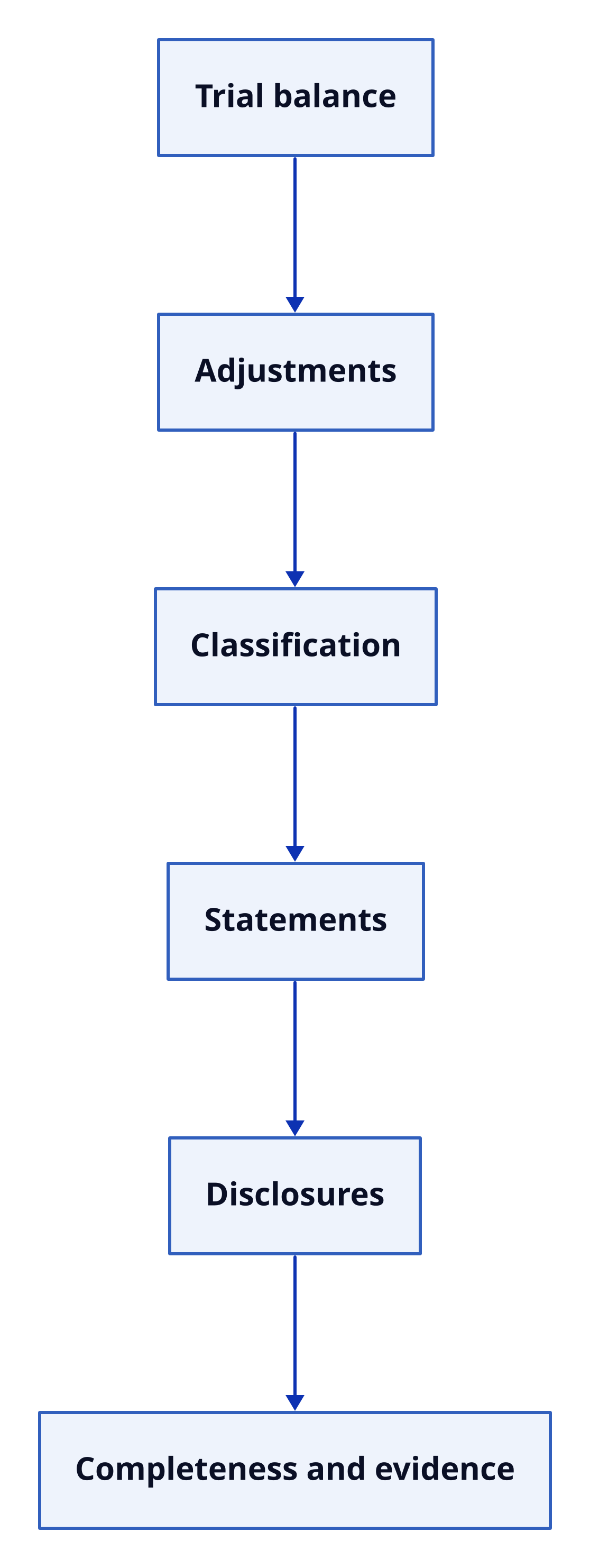
A reporting review is a trace, not just a final arithmetic check. Follow the information from the trial balance through adjustments, classifications, statements, disclosures, and evidence that the package is complete. At each stage, ask whether the amounts are supported and whether important facts have been carried forward.
Text description
Trace the reporting review A downward flowchart of six process steps: Trial balance, Adjustments, Classification, Statements, Disclosures, and Completeness and evidence. Each step connects to the next. Layout: down. Trial balance Adjustments Classification Statements Disclosures Completeness and evidence Trial balance → Adjustments Adjustments → Classification Classification → Statements Statements → Disclosures Disclosures → Completeness and evidence
Start by confirming that the original trial balance’s debits and credits agree. Then verify each adjustment: it should have support, belong in the reporting period, be posted once, and recalculate correctly. For example, Northstar’s six-month interest accrual is $20,000 × 8% × 6/12 = $800. The reviewer checks both the calculation and its support, rather than relying only on the fact that the adjusting entries balance.
Next, test classifications against the underlying facts and applicable requirements. Northstar’s remaining $10,000 customer advance stays a liability because the related service is still owed; its note is classified as long-term because it is not due within one year of the reporting date.
Then check how the statements connect. Northstar’s beginning retained earnings of $20,000 plus net income of $2,325, with no dividends, gives ending retained earnings of $22,325. Its balance sheet also balances: total liabilities of $43,575 plus equity of $62,325 equals total assets of $105,900.
These checks are necessary, but they do not establish that the package is complete. Compare reported balances and risks with contracts, legal correspondence, estimates, and relevant events after year-end. For example, the stated legal claim is reasonably possible, not probable; the review should check the correspondence and ensure the matter and estimated range are disclosed as described in the case, rather than accrued under those assumptions.
Finally, obtain information that the records do not supply. Northstar’s debt agreement is needed for a complete debt note, and the case does not specify its depreciation method or useful lives. The available information is also insufficient for a reliable cash-flow statement: revenue or net income alone does not establish cash received or paid. A balanced balance sheet is an important consistency check—not proof that the statements and notes are complete.
: A review that follows accounting information from the trial balance through the statements and notes, checking support, accuracy, consistency, classification, and completeness.