

Managing Soil Fertility
A practical guide to matching fertilizer, organic amendments, and lime to crop needs, then combining those decisions in a nutrient budget and integrated fertility plan.
Choose Nutrient Sources and Correct Soil Acidity
Let soil tests and crop needs guide the source
Soil fertility management is not simply a matter of adding nutrients. Soil-test results and crop needs help determine which nutrients are needed and which source is appropriate. Fertilizers provide concentrated nutrients with a stated analysis. Organic amendments can supply nutrients too, while also adding organic matter. Lime has a different purpose: it is used to neutralize soil acidity and raise pH.
A such as 10-5-10 generally means that, by weight, the product contains 10% nitrogen (N), 5% phosphate (P₂O₅), and 10% potash (K₂O). The second and third numbers refer to phosphate and potash forms, not elemental phosphorus and potassium. Follow the product label and the units used in the soil-test recommendation.
Choose a product that supplies what the soil and crop need. For example, if a soil test calls for nitrogen but shows phosphorus and potassium are adequate, a nitrogen-only product may be a better fit than one that adds more of those nutrients. Applying more than needed can waste money and increase the risk of nutrient losses.
Calculate product rate from nutrient need
To find the amount of product needed for a specified nutrient, divide the nutrient requirement by the nutrient fraction in the product. A 20% N fertilizer contains 0.20 lb N per pound of product. If the crop needs an additional 60 lb N per acre:
This calculates the product rate for the nitrogen requirement only. It does not account for other nutrients the product may supply, so check its full analysis and include any phosphorus or potassium in the overall plan.
Account for organic amendments over time
Manure, compost, crop residues, and cover crops can provide nutrients and add organic matter. Organic matter supports soil structure and water retention, while biological activity helps cycle nutrients. Unlike a product with a stated fertilizer analysis, an organic amendment’s nutrient content and availability can vary with the material and how it is managed. Nutrients may be released gradually, so not all may be available to the next crop.
Test manure and other nutrient-rich amendments when possible, and use locally appropriate estimates of . Include nutrients expected to become available in later years when planning future applications; otherwise, a later nutrient release could contribute to excess. Compost may improve soil properties, but its nutrient balance may not match a crop’s needs. Applying enough compost to meet one nutrient need can therefore supply too much of another.
Treat lime as a soil-acidity decision
Soil pH affects nutrient availability and root growth. commonly uses calcitic or dolomitic limestone to neutralize soil acidity and raise pH. A soil test and crop-specific recommendation should guide whether lime is needed and what target pH to use; do not apply it automatically. A lime recommendation depends on more than the measured pH: reserve acidity and the target pH also matter.
Lime products differ in neutralizing ability and fineness, so the amount of a particular product required can differ from a standard recommendation. Incorporation and sufficient reaction time can improve effectiveness. Gypsum and Epsom salts do not neutralize soil acidity, so they should not be assumed to substitute for limestone.
Budget Nutrients Before Applying Them
A compares the crop’s recommendation with nutrients already supplied or expected from all relevant sources. Depending on the crop and local recommendation system, possible sources include soil-test results, manure and compost, previous legume crops, crop residues, irrigation water, and commercial fertilizer. Crediting these supplies helps avoid both shortages and overapplication.
The basic relationship is:
For example, suppose a crop recommendation calls for 120 lb of plant-available N per acre. An amendment is estimated to supply 50 lb of available N per acre, and a previous crop is credited with 20 lb. Subtract both credits:
This is an illustrative calculation, not a universal recommendation. Real plans need site-specific soil tests, amendment analyses, crop needs, and locally calibrated guidance. Use relevant estimates of nutrient availability, and do not count the same supply twice—for example, once as a manure credit and again as a separate fertilizer application. Consider crop removal and residual nutrients across the rotation as well.
Build and Review an Integrated Fertility Plan
brings soil testing, nutrient sources, pH correction, and decisions across crop rotations into one plan. Mineral fertilizers provide concentrated nutrients with known analyses; organic sources can supply nutrients and add organic matter. Guided by testing and nutrient credits, these sources can complement one another. The goal is to match nutrient supply to crop demand while supporting productive soil and limiting losses—not simply to apply more.
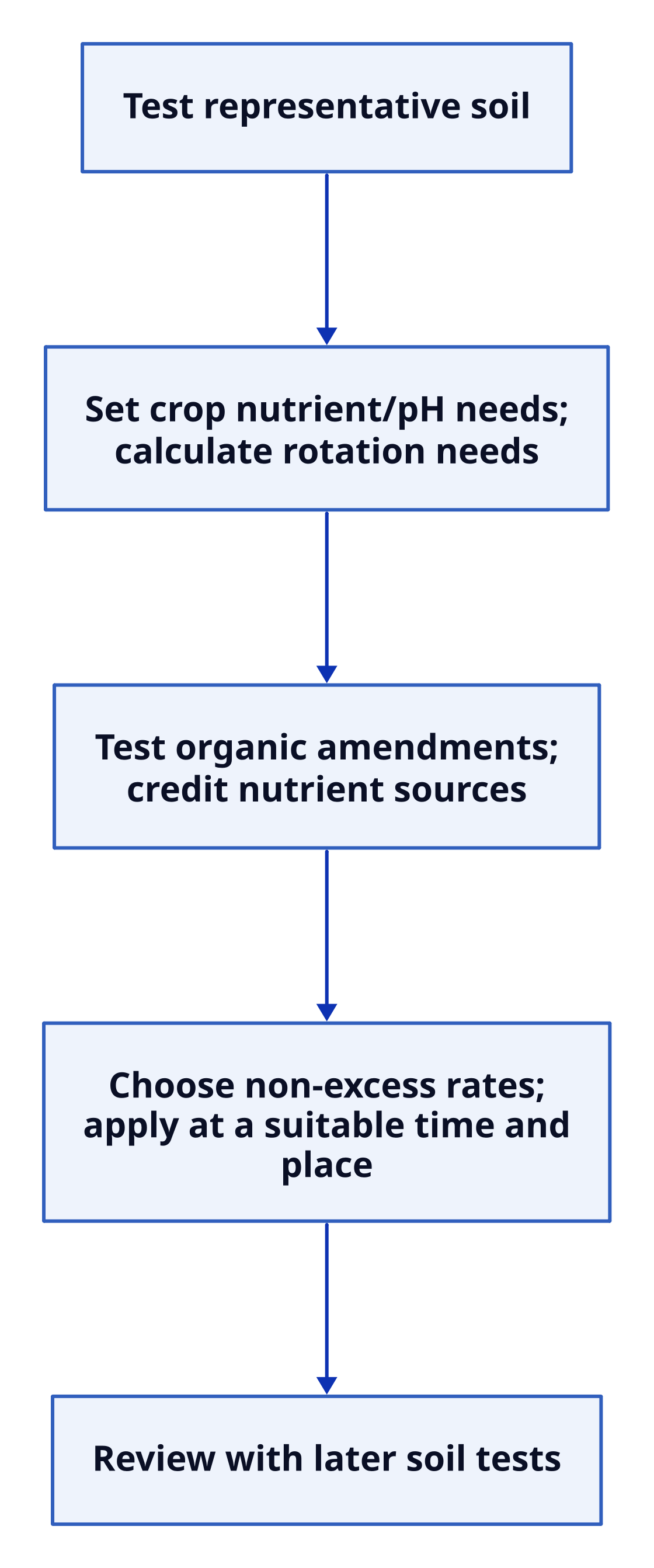
The help organize decisions: choose the right nutrient source, rate, time, and place. In practice, start by testing representative soil and identifying crop-specific nutrient and pH needs. Set realistic crop goals and calculate nutrient needs across the rotation. Then test organic amendments, credit nutrient contributions from all sources, and choose rates that meet remaining needs without creating excesses. Apply nutrients at a time and place that support crop uptake and reduce losses, then review the results.
Text description
Fertility planning sequence A downward flowchart links five process steps in order: test representative soil; set crop nutrient and pH needs and calculate needs across the rotation; test organic amendments and credit nutrient sources; choose remaining rates and apply at a suitable time and place; review with later soil tests. Layout: down. Test representative soil Set crop nutrient/pH needs; calculate rotation needs Test organic amendments; credit nutrient sources Choose non-excess rates; apply at a suitable time and place Review with later soil tests Test representative soil → Set crop nutrient/pH needs; calculate rotation needs Set crop nutrient/pH needs; calculate rotation needs → Test organic amendments; credit nutrient sources Test organic amendments; credit nutrient sources → Choose non-excess rates; apply at a suitable time and place Choose non-excess rates; apply at a suitable time and place → Review with later soil tests
Rotations, legumes, cover crops, residue management, and appropriate application methods can support nutrient cycling and reduce losses. Subsequent soil tests help assess results and inform future decisions. Adapt recommendations to local soils, climate, crops, and applicable requirements.
: A nutrient amount from a source that is counted toward meeting the crop’s nutrient requirement.