

Mitigation and Adaptation in Climate Policy
Understand how mitigation and adaptation address different parts of the climate challenge and why effective policy uses them together.
Two Complementary Responses to Climate Change
Two responses, two purposes
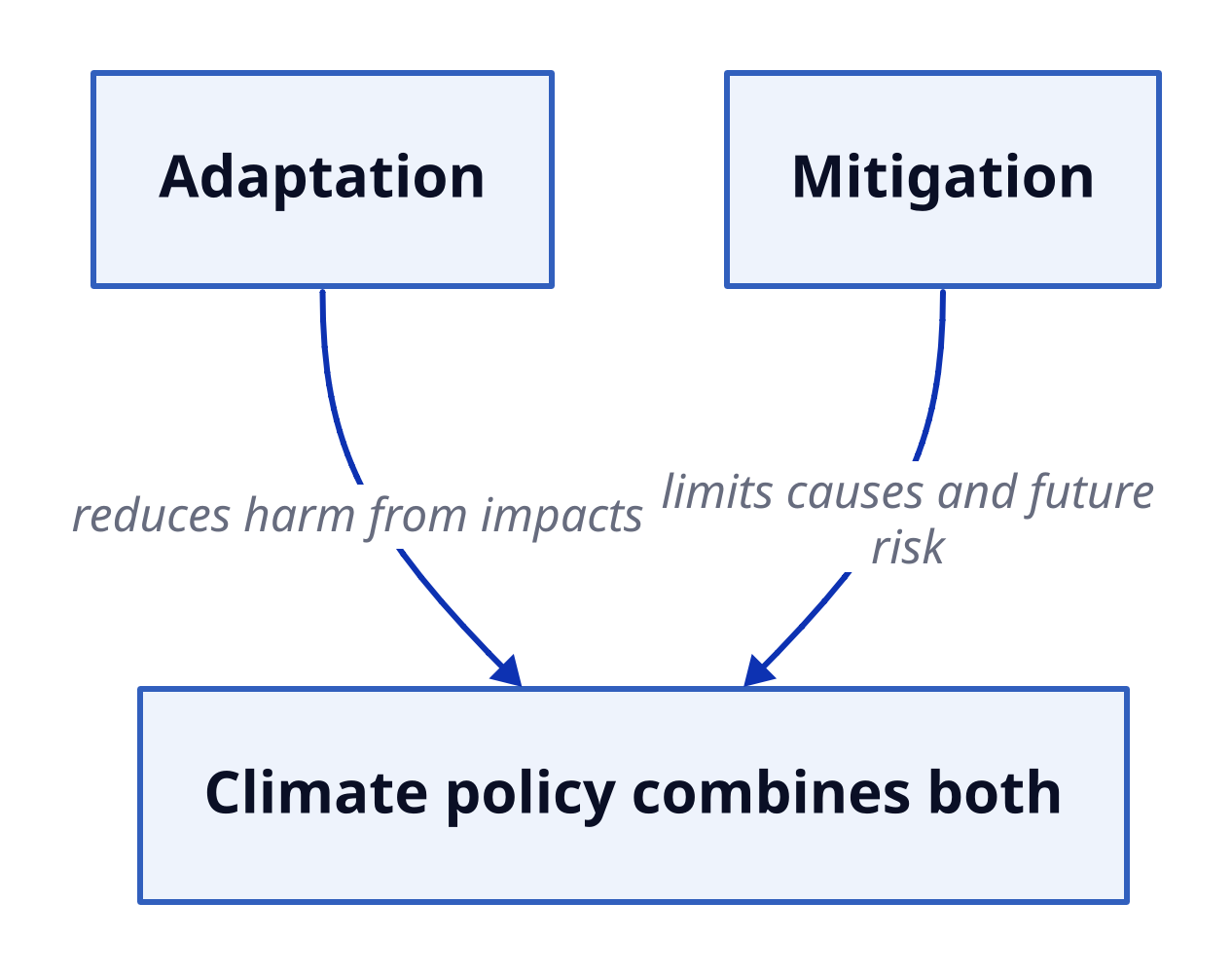
Climate policy addresses both the causes of climate change and its effects. Mitigation reduces greenhouse-gas emissions or increases carbon removal, helping limit future warming and risk. Adaptation adjusts people, infrastructure, and ecosystems to actual or expected climate impacts, reducing the harm they cause.
These approaches are complementary, not interchangeable. A flood barrier may reduce flood damage in a particular place, but it does not reduce emissions. Likewise, low-emissions electricity can address a cause of future warming, but on its own it does not protect people from heat that is already expected.
Text description
Complementary responses Two boxes labeled “Mitigation” and “Adaptation” each point to a box labeled “Climate policy combines both.” Layout: down. Mitigation Adaptation Climate policy combines both Mitigation → Climate policy combines both (limits causes and future risk) Adaptation → Climate policy combines both (reduces harm from impacts)
Measures can have one or both benefits
The source’s examples show why both responses matter. Urban trees can provide shade, helping people cope with heat, and store carbon, contributing to mitigation. Efficient buildings can lower emissions and improve comfort during heat. Those combined benefits depend on how the measures are designed and, for buildings, powered.
Effective climate policy therefore limits the scale of future climate change through mitigation while strengthening the ability to cope with impacts already occurring or expected through adaptation. Neither response makes the other unnecessary.