

Revising Performance Through Feedback
Learn how specific feedback and repeated comparison can guide purposeful changes in rehearsal.
A Goal-Driven Cycle of Revision
Revision starts with a goal
Rehearsal is more than repeating lines. It is a process of checking whether choices communicate the intended story, then adjusting them. Start by naming a clear —for example, making a character’s decision easy to understand. Perform enough of the scene to reveal the issue in context; a brief moment may not show whether a choice works across the exchange.
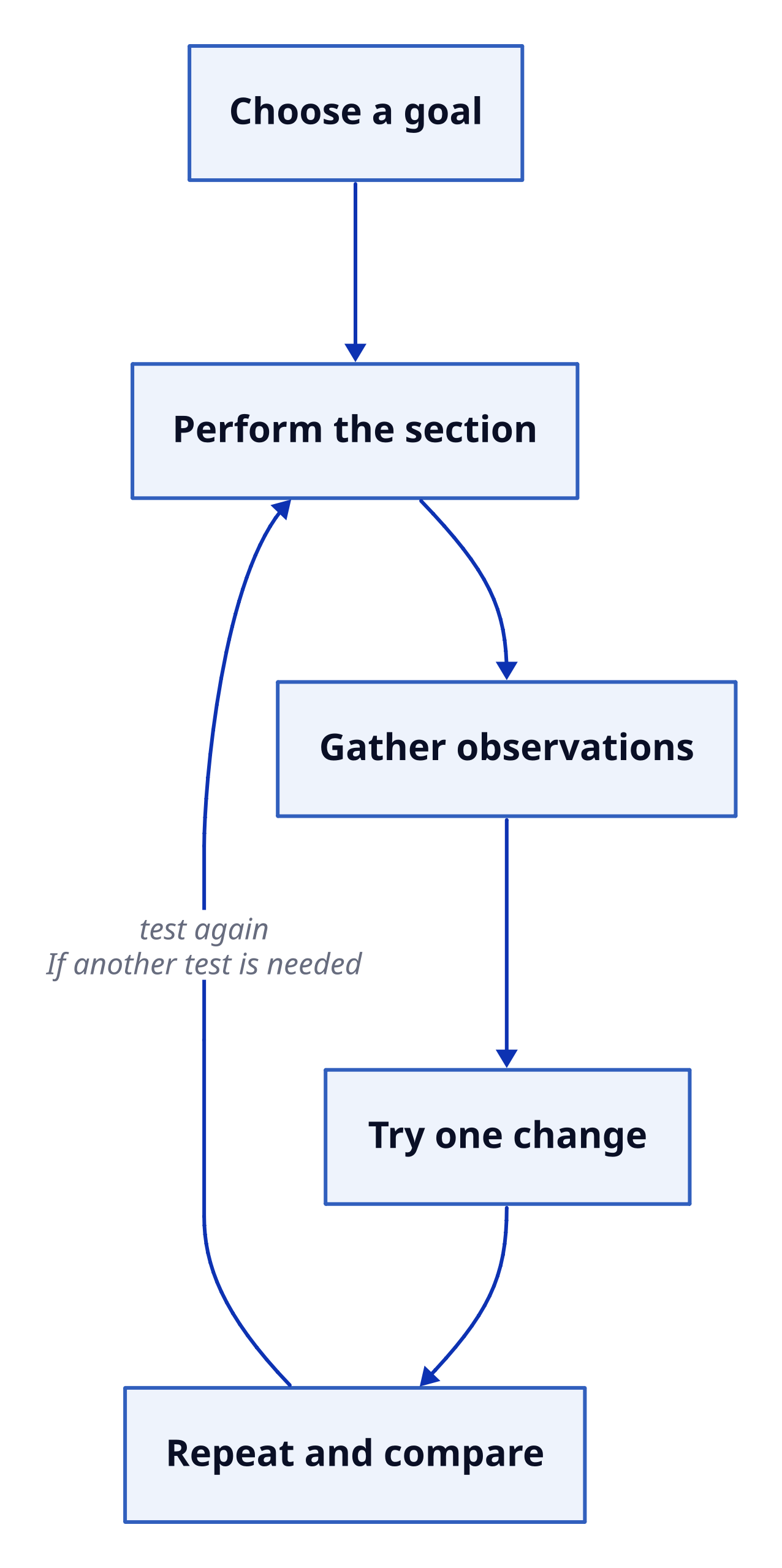
Text description
The revision cycle A downward flowchart with five steps: choose a goal, perform the section, gather observations, try one change, and repeat and compare. An arrow from repeat and compare back to perform the section indicates that another test can be made. Layout: down. Choose a goal Perform the section Gather observations Try one change Repeat and compare Choose a goal → Perform the section Perform the section → Gather observations Gather observations → Try one change Try one change → Repeat and compare Repeat and compare → Perform the section (test again) — If another test is needed
Turn observations into a test
is most useful when it is specific, observable, and connected to the goal. Compare “That scene was confusing” with the observation: “I could not tell when the character changed their mind because the pause before the final line was very short.” The second comment identifies a moment and a possible reason the turning point did not come across. Performers can test a longer pause, then compare the result with the goal: did the decision become clearer?
Try one deliberate change at a time—perhaps a pause, vocal emphasis, gesture, position, or entrance. That makes it easier to notice what changed. can come from performers, a director, designers, observers, or self-review; a recording may help reveal choices performers missed while acting.
Consider ; do not simply obey it
Look for patterns across comments, but treat suggestions as evidence to weigh, not commands. Ask whether a proposed change serves the scene’s purpose and fits the group’s shared interpretation. Different viewers may notice different things, so a comment is a reason to examine a choice—not automatic proof that one solution is right.
After repeating the scene, keep a change if it better serves the work. If it does not, try another approach and compare again. This cycle applies to acting, staging, timing, and technical elements: each revision should be judged by how well it supports the scene’s intended communication.