

Scene Safety in Suspected Poisoning
A focused lesson on recognizing poisoning scene hazards and preventing secondary contamination before patient contact.
Recognize Hazards Before Approaching
Make the scene safe before approaching
At a suspected poisoning, pause to look for signs of an unsafe scene: fumes, spills, powders, leaking containers, placards, multiple people with similar symptoms, or someone who suddenly became ill in an enclosed space. These are warning clues, not proof of a particular substance. A patient may also appear well at first, so appearance alone does not establish that the scene is safe.
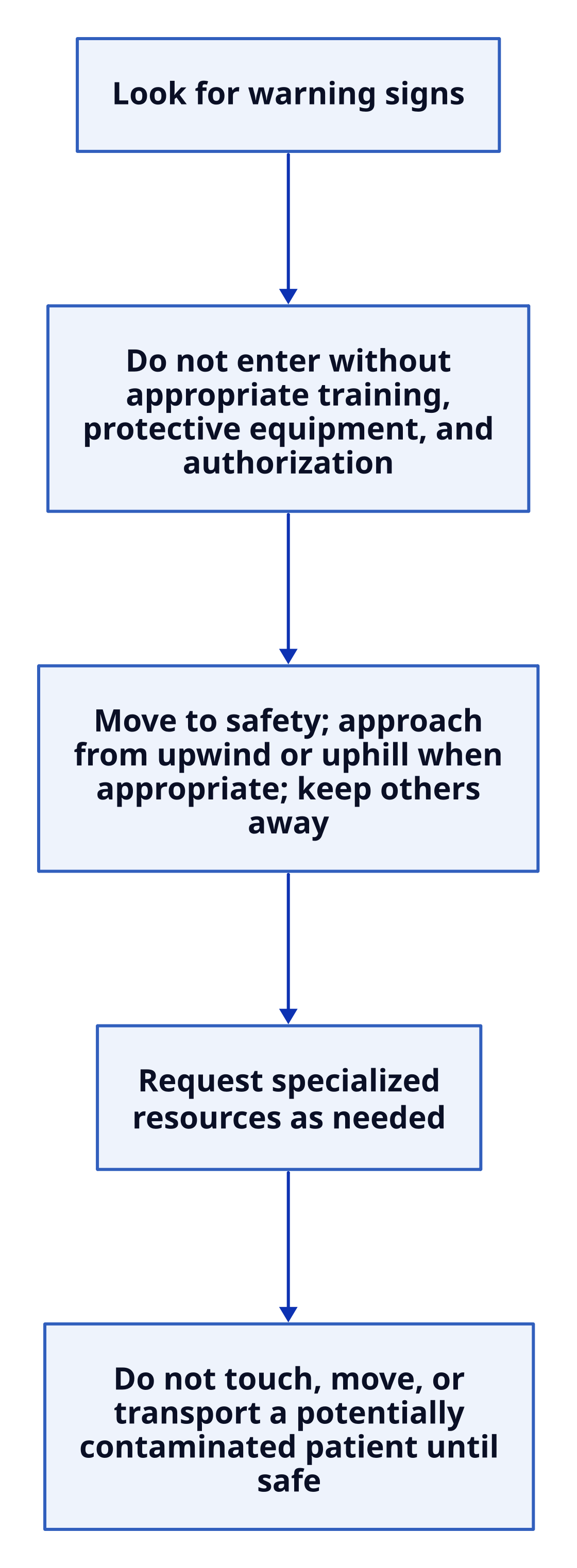
Do not enter a suspected contaminated or oxygen-deficient area unless you have the appropriate training, protective equipment, and authorization. Move to safety, approach from upwind or uphill when appropriate, keep others away, and request fire, hazardous-materials, or specialized decontamination resources as needed. A contaminated patient, clothing, or emesis can expose responders and the ambulance. Therefore, do not touch, move, or transport a potentially contaminated patient until it is safe. Follow incident-command and decontamination procedures.
The practical order is to recognize possible hazards, protect people from exposure, and wait for the scene to be safe before patient contact. Scene safety is a prerequisite to care—not a reason to enter without the required protections.
Text description
Scene safety before patient contact A downward flowchart: identify warning signs; do not enter without appropriate training, protective equipment, and authorization; move to safety, approach from upwind or uphill when appropriate, and keep others away; request specialized resources as needed; wait until it is safe before touching, moving, or transporting a potentially contaminated patient. Layout: down. Look for warning signs Do not enter without appropriate training, protective equipment, and authorization Move to safety; approach from upwind or uphill when appropriate; keep others away Request specialized resources as needed Do not touch, move, or transport a potentially contaminated patient until safe Look for warning signs → Do not enter without appropriate training, protective equipment, and authorization Do not enter without appropriate training, protective equipment, and authorization → Move to safety; approach from upwind or uphill when appropriate; keep others away Move to safety; approach from upwind or uphill when appropriate; keep others away → Request specialized resources as needed Request specialized resources as needed → Do not touch, move, or transport a potentially contaminated patient until safe
: Clues such as fumes, spills, powders, leaking containers, placards, several people with similar symptoms, or sudden illness in an enclosed space.
: Preventing a harmful substance from spreading to responders, equipment, or the ambulance.