

The Five-Step Revenue-Recognition Framework
Learn how Topic 606 and the broadly converged IFRS 15 model connect contract promises and expected consideration to the timing of revenue recognition.
From Contract Promises to Revenue Recognition
The framework’s central idea
Under U.S. GAAP Topic 606 and the broadly converged IFRS 15 model, revenue is recognized to depict the transfer of promised goods or services to a customer. The amount recognized reflects the consideration the entity expects to receive in exchange. The framework therefore connects what the contract promises, the consideration for those promises, and when the entity performs.
Text description
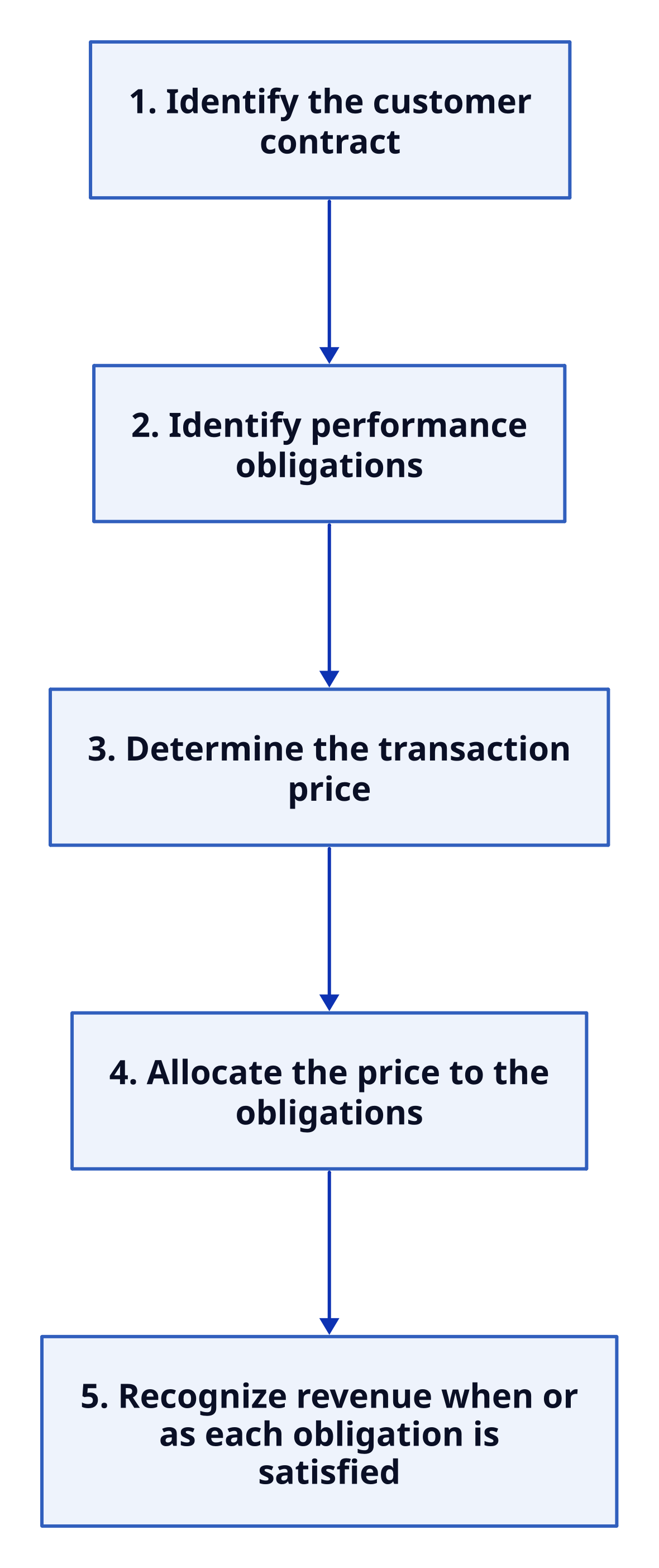
Five-step revenue-recognition framework A downward sequence of five connected steps: identify the customer contract; identify performance obligations; determine the transaction price; allocate the transaction price to the performance obligations; recognize revenue when or as each obligation is satisfied. Layout: down. 1. Identify the customer contract 2. Identify performance obligations 3. Determine the transaction price 4. Allocate the price to the obligations 5. Recognize revenue when or as each obligation is satisfied 1. Identify the customer contract → 2. Identify performance obligations 2. Identify performance obligations → 3. Determine the transaction price 3. Determine the transaction price → 4. Allocate the price to the obligations 4. Allocate the price to the obligations → 5. Recognize revenue when or as each obligation is satisfied
How the steps connect
The first step identifies the customer contract whose promises and consideration are being considered. The second identifies its . This step is pivotal: those obligations establish the units to which the is allocated, and they are also the units against which revenue recognition is assessed.
Next, the entity determines the —the consideration it expects to receive—and allocates that price to the identified obligations. Allocation links the amount of consideration to the contract’s specific promises. Finally, revenue is recognized when—or as—each obligation is satisfied. Thus, the conclusion about revenue recognition is assessed obligation by obligation, using the same units established when the promises were identified.
The sequence is more than a checklist: each step supplies information needed for the next. In particular, determining the obligations before allocating the price makes clear what the allocation applies to and what performance will later be assessed. The framework’s endpoint is not simply the signing of a contract or the determination of a price; it is recognition tied to satisfaction of the promised obligations.