

Foodservice Operations and Service Models
A practical guide to coordinating foodservice resources, production, customer service, safe workflow, and operational improvement.
The and Consistent Procedures
The connects decisions to results
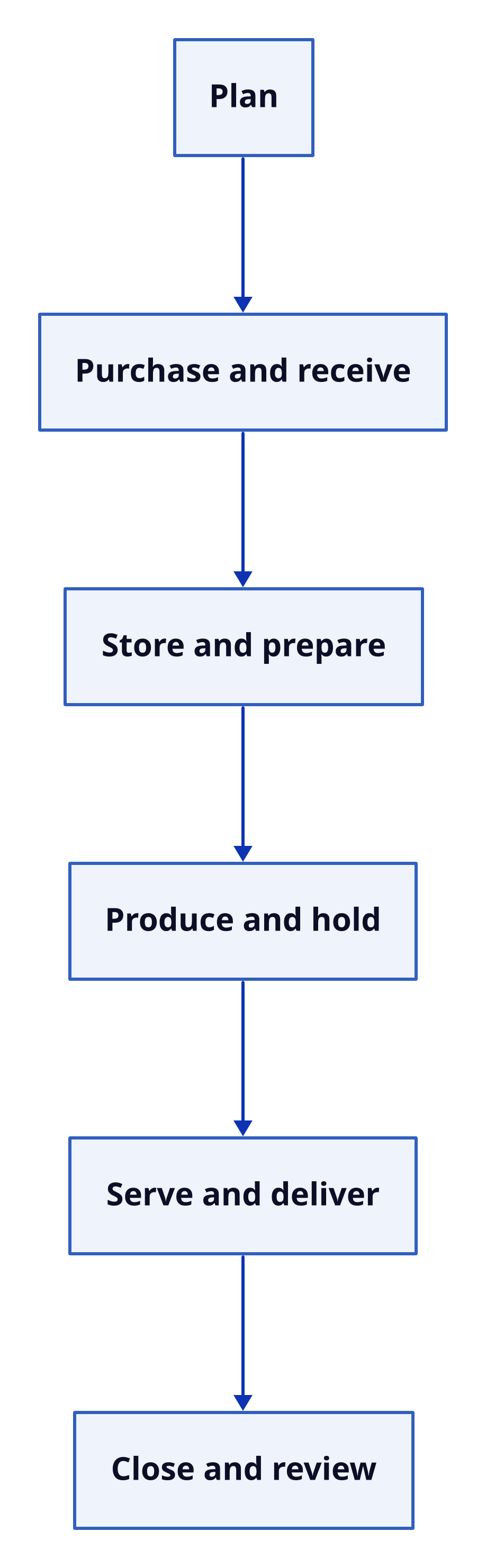
Foodservice work is a chain of linked decisions and tasks, not a set of isolated stations. Planning starts the cycle: managers set the menu, forecast demand, schedule production, and determine staffing and equipment needs. The menu influences what must be purchased, how ingredients are stored and prepared, and what service will require.
Next, the operation purchases and receives supplies, inspects deliveries, and moves accepted goods into appropriate storage. Staff then organize inventory and prepare ingredients according to recipes and production schedules. During production, food is cooked or assembled in planned quantities, with timing coordinated so items are ready together and safety and quality controls are maintained. Service and delivery must manage accuracy, pace, special requests, and guest communication. At closing, staff clean and reset work areas, record required checks, reconcile inventory or sales, and use the results to improve the next shift.
The cycle feeds back into planning: what the team learns at close can inform the next . For example, reviewing sales and inventory helps connect the current shift’s results to future decisions rather than treating review as paperwork detached from operations.
Text description
Foodservice operating cycle A downward flowchart with six connected process boxes: Plan; Purchase and receive; Store and prepare; Produce and hold; Serve and deliver; Close and review. Layout: down. Plan Purchase and receive Store and prepare Produce and hold Serve and deliver Close and review Plan → Purchase and receive Purchase and receive → Store and prepare Store and prepare → Produce and hold Produce and hold → Serve and deliver Serve and deliver → Close and review
SOPs make recurring work consistent
An SOP turns a repeated task into a shared procedure. A useful procedure identifies who performs it, what is needed, where and when it happens, and how to do it. These details help employees understand both their responsibility and the expected way to complete the task. SOPs can guide service routines as well as food-safety practices; they support consistency across shifts without replacing the operation’s broader planning and review.
Production Systems and Service Models
Two different choices shape an operation
A describes where and how food is prepared and moved before service. A describes how customers order, pay, receive food, and interact with staff. They answer different questions: an operation might prepare food centrally and then serve it through a cafeteria, or prepare it on site and offer takeout. Choosing one does not automatically determine the other.
| System | Typical food path | Operational consideration |
|---|---|---|
| Conventional | Prepared and served at the same site, often near mealtime | Needs enough on-site space, equipment, and labor during production peaks. |
| Ready-prepared | Prepared ahead, chilled or frozen, stored, then reheated or finished | Plan storage, safe temperature control, reheating, and scheduling. |
| Commissary (centralized) | Central kitchen prepares food for transport to service locations | Coordinate transport, timing, and receiving at each location. |
| Assembly-serve | Mostly prepared products are received, stored, assembled or heated, and served | Can reduce on-site preparation while increasing reliance on suppliers and purchased products. |
Service models organize the guest-facing handoff
Table service: Staff take orders from seated guests and deliver food. It allows personalized service, but hosts, servers, and kitchen staff need to coordinate pacing.
Counter or quick service: Guests order—and often pay—at a counter or kiosk, then collect food or receive it at a table. Clear order identification and pickup procedures help prevent errors and congestion.
Cafeteria or buffet: Guests select food from a line or display. The operation must manage replenishment, portioning, cleanliness, and customer movement.
Takeout and delivery: Orders are packaged for handoff or transport. Labels, order checks, suitable packaging, and a defined pickup area support accuracy and help separate these orders from dine-in traffic.
Catering or banquet service: Food and service are planned for an event, often with a fixed guest count and schedule. Production, transport, setup, and service timing should be agreed in advance.
These models—and differences in portioning and presentation—should fit guest expectations and the operation’s staffing, menu, layout, and production capacity. Production choices must fit too. For instance, an operation may prepare some foods on site while purchasing ready-to-serve items; it need not use one system for every menu item. The right combination depends on menu, volume, facilities, workforce, distribution needs, and desired product quality.
Workflow, Timing, and Food Safety
Arrange work around the food path
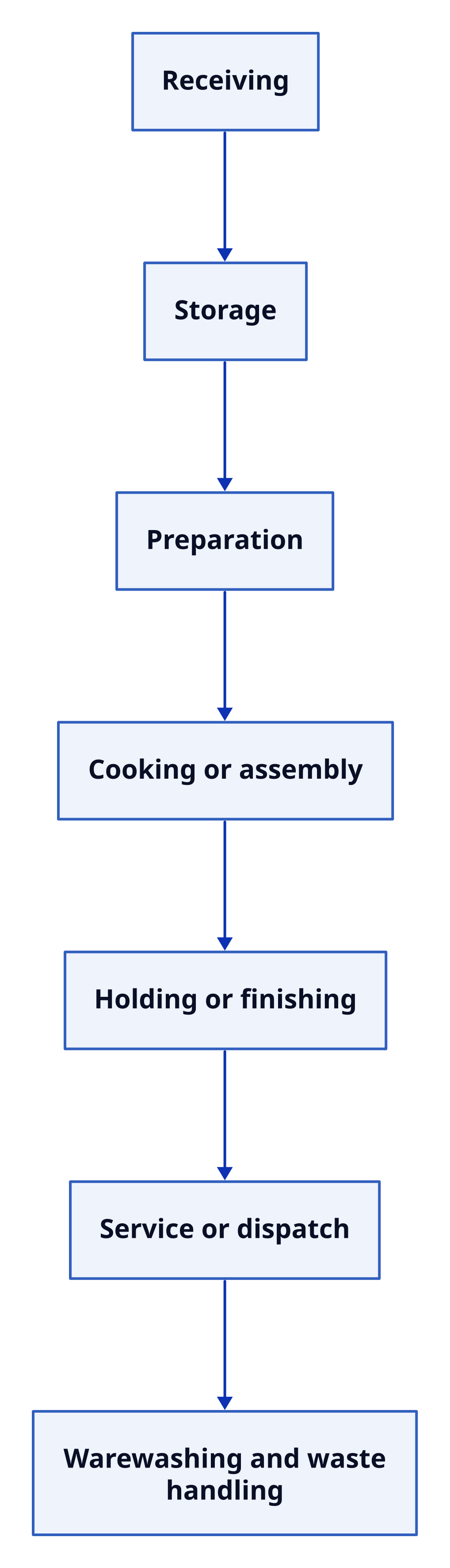
A sound workflow moves food, people, equipment, and information with as little unnecessary crossing, waiting, and rework as practical. A typical food path runs from receiving and storage through preparation, cooking or assembly, holding or finishing, and service or dispatch, then to warewashing and waste handling.
Layout can make that path easier to follow. Receiving and storage should allow efficient access to ingredients; preparation should be near the equipment and stations that use them; and completed orders need a clear route to servers or pickup points. Where practical, keep the route for clean food and supplies distinct from the return path for used dishes and waste. Layout decisions should also consider staffing, equipment spacing, handwashing access, and food flow.
Text description
Typical food path A downward flowchart with seven connected process boxes: Receiving; Storage; Preparation; Cooking or assembly; Holding or finishing; Service or dispatch; Warewashing and waste handling. Layout: down. Receiving Storage Preparation Cooking or assembly Holding or finishing Service or dispatch Warewashing and waste handling Receiving → Storage Storage → Preparation Preparation → Cooking or assembly Cooking or assembly → Holding or finishing Holding or finishing → Service or dispatch Service or dispatch → Warewashing and waste handling
Match production timing to demand—and build in safety
A identifies what must be prepared, in what quantity, by what time, and by whom. Batch cooking can help match output to demand. Timing matters: preparing too early may reduce quality, while preparing too late can delay orders. Managers adjust plans when reservations, sales patterns, staffing, or equipment availability change.
Safety checks belong throughout the workflow, not only at the end. In the United States, the FDA Food Code is a model used by jurisdictions as a basis for local requirements; operators should follow the requirements adopted by their state or local authority. The Code includes handwashing requirements at appropriate task changes, including switching between raw food and ready-to-eat food.
Team Coordination and Operational Improvement
Assign work, then connect the teams
Staffing starts with the work to be done. Managers estimate demand, identify tasks and required skills, assign coverage by station and shift, and plan backup coverage for breaks, absences, and rush periods. Clear role assignments show who owns each task and whom to notify if a problem arises.
The generally includes guest-facing roles such as hosts, servers, cashiers, and bussers. The includes food production, dishwashing, and related kitchen work. These are distinct but interdependent: the kitchen needs accurate orders and timely updates, while service staff need reliable information about preparation times, availability, and special requests.
Coordination can be made routine. Pre-shift briefings review expected volume, menu changes, unavailable items, special requests, station assignments, and safety reminders. Shared order systems, consistent item names, and procedures for confirming modifications and allergies support clear communication. Teams also need defined handoff points, prompt updates about delays, substitutions, shortages, remakes, or equipment problems, and shift handovers that cover unfinished tasks, inventory, maintenance, and relevant guest or event details.
Trace a lunch order through its handoffs
In the source example, a cashier enters two meals, one with a clearly recorded modification. The shared ticket system sends the order to the kitchen. The kitchen confirms the modification and prepares both meals to be ready together. At the pass, a designated employee checks the plates against the ticket. A server or pickup employee then delivers the correct order and reports any issue through the agreed channel.
Each handoff depends on the one before it: the kitchen needs the recorded order, the checker needs the ticket to compare with the plates, and the person delivering the order needs the checked handoff. A breakdown at any point can cause delay or error. A shared system, clear responsibilities, and a known channel for updates help the teams coordinate the work.
Use indicators to find opportunities to improve
Managers can monitor order accuracy, ticket or wait time, food waste, labor hours, customer feedback, and completion of required safety checks. These indicators help locate bottlenecks and guide practical changes. For example, if an operation identifies a delay at a station, it might adjust station assignments; it might revise a preparation schedule or improve the handoff area when those are where work is getting held up. The useful response depends on what the indicators show, so review should connect measured results to a specific operational adjustment.
: A written procedure that makes a recurring task consistent by specifying who does it, what is needed, where and when it occurs, and how it is performed.
: A measure used to monitor operations, locate bottlenecks, or guide improvement.