

Foodservice Workflow and Daily Operations
A practical guide to tracing food and orders through service, arranging safe and efficient workstations, clarifying staff handoffs, and improving delays without compromising quality or food safety.
Map the Work from Receiving to Service
Start with the menu, then trace an order
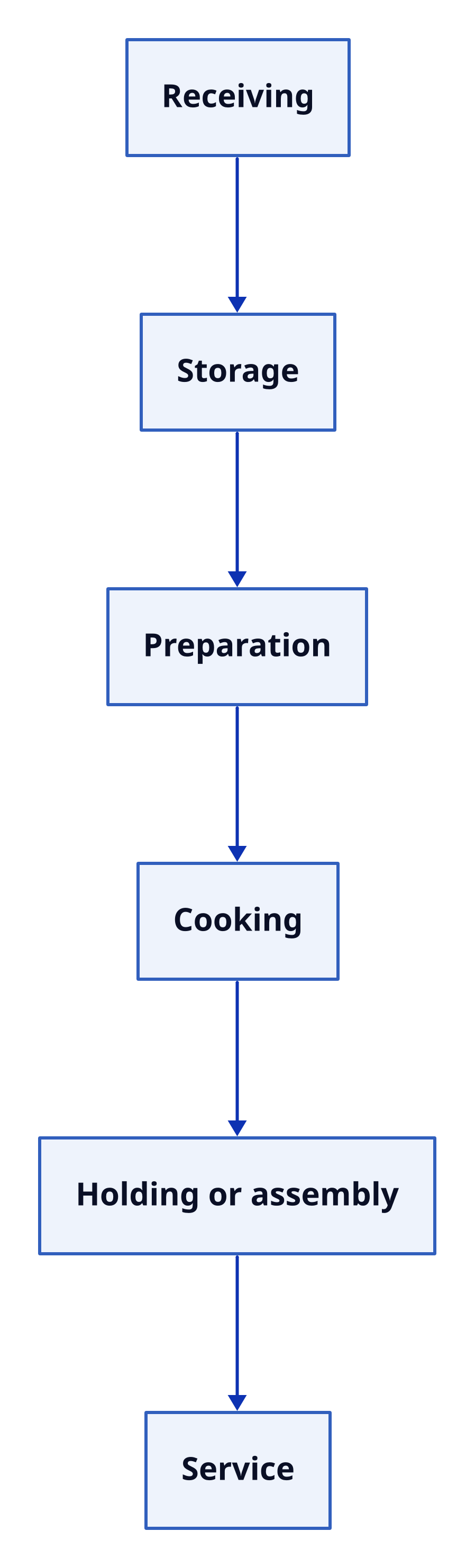
The menu and service method determine which tasks, equipment, and staff are needed. Start by tracing a typical product or order from receiving ingredients through service. A common route is receiving, storage, preparation, cooking, holding or assembly, and service. This is a useful starting map, not a universal route: some foods also require cooling and reheating, so include those steps when they apply.
For each step, record what happens and where it happens, including the equipment and tools used. Also identify who is responsible and who takes over next. Include timing and volume—especially how much work must be completed during a peak period—and mark checks for food safety, quality, order accuracy, and presentation.
Text description
A common food-flow route A downward flowchart shows receiving leading to storage, then preparation, cooking, holding or assembly, and service. Layout: down. Receiving Storage Preparation Cooking Holding or assembly Service Receiving → Storage Storage → Preparation Preparation → Cooking Cooking → Holding or assembly Holding or assembly → Service
Example: map a made-to-order lunch
For a grilled sandwich with a side salad, the source example traces work from storage through preparation, grilling, cold assembly, an order check, and service. It places sandwich ingredients near assembly and salad ingredients and tools at cold prep. The ticket carries the requested items and special instructions; the grill cook signals when the sandwich is ready, and the assembler or expo checks the complete order against the ticket before handing it to the runner. When documenting this route, record actual step times and peak volume rather than assuming them.
Check the map against a real shift
Written procedures show the intended process; observing a shift shows how work actually moves. Compare the two and note interruptions, restocking trips, waiting, and rework. These details matter because a map that leaves out routine delays or detours may not represent the work staff need to manage.
Arrange Stations for Flow and Safety
Place stations along the work’s route
Arrange related tasks into workstations and keep frequently used ingredients, tools, and equipment near where they are needed. Place stations in the order work normally moves. This helps staff progress through the process without repeated backtracking or unnecessary crossings of paths.
The best layout depends on what the operation produces and how it works during its busiest periods. A layout should also remain flexible enough to accommodate changes in tasks or volume.
| Layout | How work is grouped | May suit |
|---|---|---|
| Straight-line or assembly | A consistent sequence | High-volume work with standardized products |
| Functional | Similar equipment or tasks together | Varied menus and smaller batches |
Plan routes for safe, uncongested work
A layout must support safe handling as well as efficient movement. Keep raw-food handling apart from ready-to-eat preparation where practicable, and provide the space and tools needed for cleaning and sanitizing. Plan routes for deliveries, staff, guests, prepared food, used dishes, and waste to limit avoidable congestion and contamination risks. Follow the applicable food code and the operation’s food-safety procedures.
Make Handoffs Explicit
Specify what happens at each transfer
A is more reliable when it does not depend on an unspoken assumption. For each one, make four things clear:
What is transferred? For example, an order ticket or a completed plate.
Who receives it? Name a role or station.
What confirms completion? Agree on a signal, such as a verbal call or ticket status.
What happens if there is a problem? Identify whom to notify about a delay, missing item, remake, or special request.
For example, a kitchen can use a designated pickup point. The cook calls when an order is complete; the expo or runner checks it against the ticket before it leaves the pass. The call signals that the order is ready, while the ticket check helps confirm that the order being handed off matches what was requested. Assigning the receiving role and a response for problems completes the plan.
Diagnose Delays and Improve the Whole Process
Look for delays—and find their cause
A is a step that cannot keep up with arriving work. It can hold up orders that are otherwise ready. Signs include queues, orders waiting between stations, idle time, repeated trips, missing supplies, and frequent remakes. Observe during peak periods as well as quieter service, and track where orders wait, how long key steps take, and when delays recur.
Do not assume every delay is caused by limited equipment or staffing. Check for poor sequencing, unclear responsibilities, equipment downtime, stock shortages, and avoidable rework as well as capacity constraints.
Test a change and check the whole process
Use a measured improvement cycle:
Observe and measure: Record where and when delays occur, including how long orders wait.
Identify the cause: Determine what is contributing to the delay rather than guessing.
Test a practical change: Options include pre-positioning approved supplies, adjusting a station, clarifying a , or shifting a task to a less-busy point in the .
Check the result: Compare waiting time, order accuracy, waste, workload, and food-safety performance before and after.
Keep a change only if it improves the whole process without creating a new problem elsewhere. Do not reduce delays by skipping required food-safety controls or quality checks. If delays persist, review staffing, equipment capacity, menu complexity, and production plans together. Communicate station responsibilities, coverage, and priorities before the rush, then adjust as demand changes.
: An area arranged for a related group of tasks, such as produce preparation or cold assembly.