

Housekeeping Facilities and Supply Management
A practical guide to coordinating public-area cleaning, managing linen, and controlling housekeeping supplies, equipment, and inventory.
Coordinating Public-Area Cleaning
Coordinating Public-Area Cleaning
Entrances, lobbies, corridors, elevators, restrooms, and other shared spaces may stay in use throughout the day. A cleaning plan helps staff cover them consistently without ignoring guest traffic or hotel operations. For each area, specify the area, task, frequency, method, responsible employee, and inspection standard. Adjust timing when occupancy, events, spills, or other conditions change. For example, a restroom may need frequent checks during busy periods, while a corridor may have scheduled vacuuming plus prompt attention to spots.
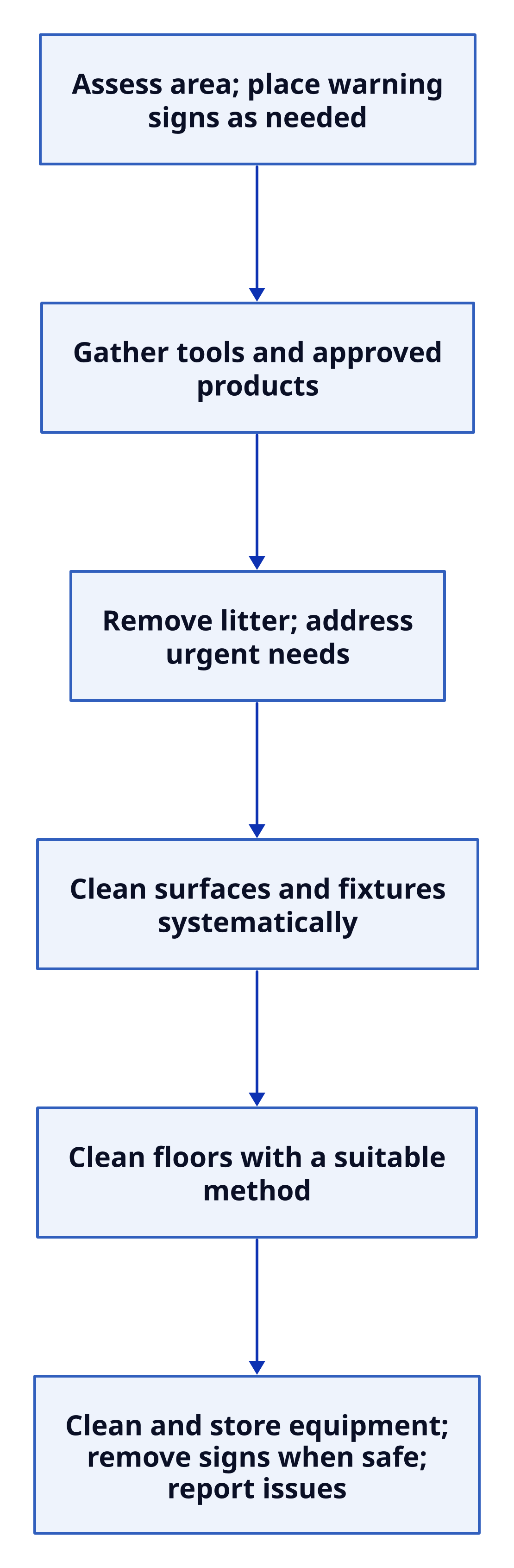
A systematic routine reduces missed work and helps prevent re-soiling. Check the area first and put out warning signs if the work could create a hazard, such as a wet floor. Gather suitable tools and approved products, remove litter and address urgent spills, then clean surfaces and fixtures in an orderly way. Choose a floor-cleaning method suited to the floor material. Finish by returning equipment for cleaning and storage, removing signs only when the area is safe, and reporting or recording maintenance issues.
Schedules and checklists support routine coverage; inspections help identify missed tasks and recurring problems. Throughout the work, protect guest privacy and keep carts and equipment from blocking public routes.
Text description
Public-area cleaning routine A downward flowchart with six connected process steps: assess the area and place warning signs as needed; gather tools and approved products; remove litter and address urgent needs; clean surfaces and fixtures systematically; clean floors with a suitable method; then clean and store equipment, remove signs when safe, and report issues. Layout: down. Assess area; place warning signs as needed Gather tools and approved products Remove litter; address urgent needs Clean surfaces and fixtures systematically Clean floors with a suitable method Clean and store equipment; remove signs when safe; report issues Assess area; place warning signs as needed → Gather tools and approved products Gather tools and approved products → Remove litter; address urgent needs Remove litter; address urgent needs → Clean surfaces and fixtures systematically Clean surfaces and fixtures systematically → Clean floors with a suitable method Clean floors with a suitable method → Clean and store equipment; remove signs when safe; report issues
Managing Linen and Setting Levels
Managing Linen and Setting Levels
Linen includes sheets, pillowcases, towels, tablecloths, and other washable textiles. Its path through collection, processing, inspection, storage, and issue is also a quality-control and accountability process: separation helps prevent contamination, inspection catches items that should not return to use, and movement records help investigate shortages or losses.
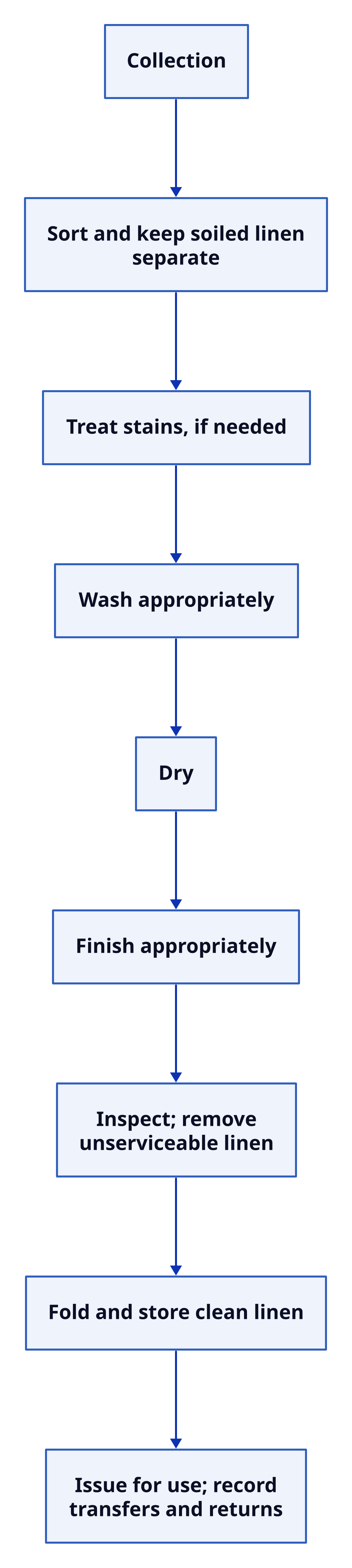
Keep clean linen separate from soiled linen during handling and transport. Sort items by fabric, color, soil level, and care instructions; treat stains when needed, then wash, dry, and finish using procedures suited to the items. Inspect finished linen for cleanliness, stains, tears, and wear. Remove unserviceable pieces from circulation and record disposal or approved reuse. Store usable clean linen in a clean, dry, orderly place protected from dust, pests, and unnecessary handling. Rotate stock so older usable items are issued first. Record transfers and returns whether linen is issued from a central linen room or floor-level storage.
Laundry may be done in-house, contracted to an outside provider, or supplied through a rental service. That choice affects staffing, equipment, delivery timing, costs, and the records needed to track linen.
A is the planned stock quantity needed to support operations. Linen plans may be expressed as complete changes per bed or as quantities that cover current use, laundry processing, and reserve. In the source example, current room use requires 100 clean bath towels, with two additional equivalent quantities held for turnaround and reserve. Thus, planned stock is towels, or three times current-use quantity. Compare actual usable stock with the plan and investigate repeated shortages, losses, or excesses. The appropriate depends on occupancy, laundry turnaround, delivery reliability, storage capacity, and replacement costs.
Text description
Linen handling flow A downward flowchart with nine connected steps: Collection; Sort and keep soiled linen separate; Treat stains, if needed; Wash appropriately; Dry; Finish appropriately; Inspect; remove unserviceable linen; Fold and store clean linen; Issue for use; record transfers and returns. Layout: down. Collection Sort and keep soiled linen separate Treat stains, if needed Wash appropriately Dry Finish appropriately Inspect; remove unserviceable linen Fold and store clean linen Issue for use; record transfers and returns Collection → Sort and keep soiled linen separate Sort and keep soiled linen separate → Treat stains, if needed Treat stains, if needed → Wash appropriately Wash appropriately → Dry Dry → Finish appropriately Finish appropriately → Inspect; remove unserviceable linen Inspect; remove unserviceable linen → Fold and store clean linen Fold and store clean linen → Issue for use; record transfers and returns
Keeping Supplies Safe, Serviceable, and Available
Keeping Supplies Safe, Serviceable, and Available
Housekeeping supplies are consumables such as detergents, disinfectants, cloths, liners, and guest-area replenishment items. Equipment ranges from mops, buckets, brushes, and vacuums to larger machines such as carpet extractors and floor scrubbers. Select both products and equipment to suit the surface, task, workload, staff capability, and approved procedures; a tool or product that is unsuitable for the job may not perform well or may cause damage.
Keep supplies in designated storage areas. Keep products in their original containers when possible, and label any authorized secondary containers. Store chemicals securely according to their labels and safety data sheets (SDS), separate from linen and guest supplies. Follow product directions for dilution and use, wear required protective equipment, and do not mix chemicals unless the manufacturer specifically permits it. In the United States, OSHA hazard-communication requirements address chemical inventories, labeling, SDS access, and employee training.
Clean and inspect reusable tools after use, let them dry as appropriate, and return them to assigned storage. Before using powered equipment, check it for damage and follow its operating instructions. Report faults promptly; a maintenance log can record inspections, repairs, and equipment taken out of service.
Inventory control connects these daily practices with purchasing and storage. Use a consistent system to receive, issue, store, count, and reorder supplies and linen. Set minimum and maximum quantities based on usage, delivery lead time, storage limits, and service requirements. Record receipts, issues, returns, transfers, damaged items, and disposals; restricting stockroom access may also be appropriate.
The planning rule is:
For the source example, a property uses 20 bottles of cleaner per week, delivery takes two weeks, and it keeps 10 bottles as . Expected use during delivery lead time is bottles; adding the reserve gives . The is therefore 50 bottles. This is a planning trigger based on the stated use, lead time, and reserve—not a universal stock quantity.
Count physical stock regularly and compare it with records. Investigate discrepancies rather than simply changing the recorded count. Rotate older usable stock first and check expiry dates where relevant; for chemicals, follow label instructions on storage and shelf life. Track usage, waste, linen loss and damage, stock-outs, and equipment repairs. These records help distinguish normal consumption from waste, loss, or ordering problems, and can guide changes to levels, staff practices, or purchasing plans.