

Planning and Tools for Climate Adaptation
A practical guide to iterative climate adaptation planning and the policy, public-service, infrastructure, ecosystem, and financial tools used to reduce climate risk.
Adaptation Planning as a Cycle
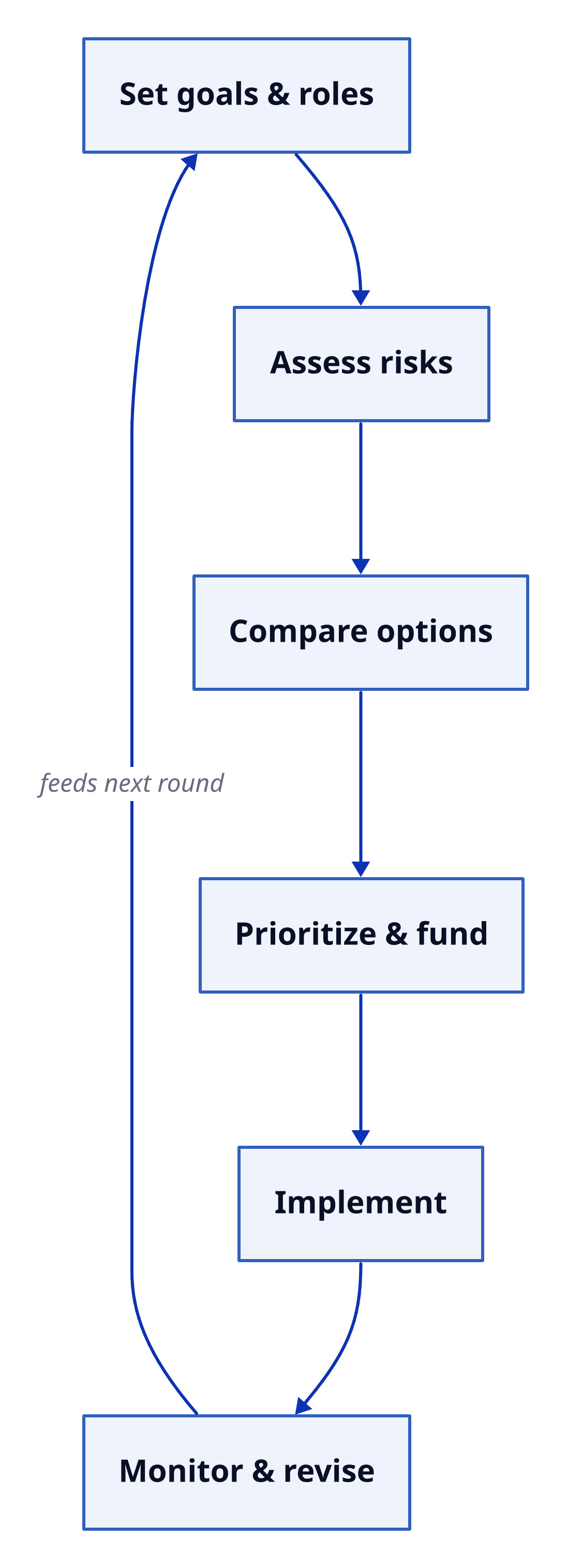
Adaptation planning is not a one-time list of projects. It is an ongoing, evidence-informed cycle: plans are developed, put into practice, checked, and revised as conditions, evidence, and community needs change. National, local, and sector plans can help connect adaptation needs with development decisions.
Text description
Adaptation planning cycle A downward flowchart links six stages: set goals and roles; assess risks; compare options; prioritize and fund; implement; monitor and revise. An arrow from the final stage back to the first shows that monitoring and revision inform the next planning round. Layout: down. Set goals & roles Assess risks Compare options Prioritize & fund Implement Monitor & revise Set goals & roles → Assess risks Assess risks → Compare options Compare options → Prioritize & fund Prioritize & fund → Implement Implement → Monitor & revise Monitor & revise → Set goals & roles (feeds next round)
A useful cycle begins by establishing leadership, responsibilities, participating communities and sectors, and coordination across levels of government. Planners then assess climate risks by combining climate information and projections with information about hazards, exposed people and assets, vulnerability, and existing coping capacity. The assessment should consider multiple hazards, uncertainty, and connections between hazards and sectors. For example, drought risks can cascade across water supplies, electricity generation, public health, and agriculture. Considering those links helps planners avoid treating each sector’s risk as isolated.
Next, planners identify and compare options. They consider feasibility, effectiveness, affordability, equity, and compatibility with development and environmental goals. They also weigh immediate actions against longer-term pathways and ask who benefits, who pays, and whether an action shifts risk elsewhere. Selected measures then need financing and integration into budgets, infrastructure investment, land-use decisions, sector programs, and relevant public or private finance. Implementation requires clear roles, staff and technical resources, and participation by affected communities and knowledge holders.
Monitoring checks both whether measures were carried out and whether they reduce vulnerability and risk. That evidence informs revisions to plans. The cycle therefore connects decisions to their results rather than assuming a planned action worked simply because it was completed.
Risk screening is especially useful early in project design. It can reveal climate and disaster risks while plans are still changeable, allowing resilience measures to be incorporated before later decisions become difficult or costly to alter. The cycle is therefore both a planning framework and a way to keep action responsive over time.
Information, Public Services, Infrastructure, and Ecosystems
Adaptation draws on a portfolio of information, public-service, regulatory, infrastructure, and ecosystem approaches. No single tool fits every risk; packages often work by connecting information about risk with decisions and practical capacity to act.
| Tool group | Examples | How it can help |
|---|---|---|
| Information and preparedness | Climate services; risk assessments; early warnings | Turn risk information into guidance and support timely preparation |
| Public services | Heat-health plans; cooling spaces; surveillance; emergency plans | Strengthen preparation and response to health risks |
| Planning and regulation | Land-use plans; zoning; building standards | Guide development away from risk or require safer design |
| Infrastructure | Resilient standards; maintenance; retrofitting; redundancy | Protect essential services and reduce dependence on one vulnerable asset or route |
| Ecosystems | Wetlands; floodplains; forests; mangroves; urban green spaces | Help regulate water, reduce some coastal or heat risks, and support biodiversity and livelihoods |
Climate services and risk assessments translate climate and hazard information into guidance that planners, farmers, utilities, health agencies, and communities can use. Early-warning systems show why information alone is not enough: they link risk knowledge, monitoring and forecasting, warning communication, and preparedness and response. The Early Warnings for All action plan organizes systems around these four linked functions. A forecast reduces risk only when people receive a clear warning in time and have the ability and resources to act. Heat-health plans, public cooling spaces, public-health surveillance, emergency plans, and public information can support responses to extreme heat; education, training, and technical support can strengthen people’s ability to prepare and respond.
Planning and regulation shape where and how development takes place. Land-use planning and zoning can steer new development away from high-risk areas, while building standards can require safer design. Risk-sensitive decisions should account for future conditions as well as present ones. For essential services, climate-resilient standards and investment can reduce disruption. Examples include drainage sized for changing rainfall, water systems designed for drought and flood risks, and energy infrastructure able to withstand heat and storms. Maintenance and retrofitting can protect existing assets; redundancy can make a system less dependent on a single vulnerable facility or route.
Where risks become difficult to reduce through protection or accommodation, managed relocation or retreat may be considered. This is not a simple technical fix: it requires careful planning and participation, with attention to rights, livelihoods, and cultural ties.
Ecosystem-based adaptation protects, restores, or manages ecosystems to help people adjust to climate impacts. Wetlands, floodplains, forests, mangroves, and urban green spaces can help regulate water, reduce some coastal or heat risks, and support biodiversity and livelihoods. Their results depend on local conditions, ecosystem health, and long-term stewardship. They are not a substitute for necessary protection or for reducing greenhouse-gas emissions.
These examples are not universal prescriptions. The appropriate mix depends on the hazard, local geography and social conditions, institutional capacity, and the needs and knowledge of affected communities. Planning should also consider how measures interact, including whether an intervention could shift risk to another place or group.
Financing Adaptation and Sharing Risk
Financing helps turn adaptation plans into action, but financial tools play different roles. Some pay for risk reduction and services; others help share financial losses after a shock. That distinction matters: transferring a loss does not, by itself, prevent physical harm.
| Tool | Role | Qualification |
|---|---|---|
| Public budgets and investment | Fund risk assessments, resilient infrastructure, ecosystem restoration, and essential services | Integrate adaptation into public decisions and spending |
| Grants and concessional finance | Help pay for adaptation measures | Particularly useful where benefits are public, costs are high, or communities have limited ability to pay |
| Insurance and risk-pooling | Transfer some financial losses after an event | Do not prevent physical harm; may be unaffordable or unavailable to high-risk groups |
| Social protection | Help households protect income, health, and livelihoods | Programs may expand or provide support after climate shocks |
| Risk disclosure and budget tracking | Make exposure visible and help follow adaptation spending | Support informed decisions and oversight |
Public budgets and investment programs can fund risk assessments, resilient infrastructure, ecosystem restoration, and essential services. Grants and concessional finance can help meet adaptation costs, especially when benefits are public, costs are high, or affected communities have limited ability to pay. These funding sources work alongside planning: selected measures need to be incorporated into budgets, investment decisions, and relevant programs to be implemented.
Insurance and risk-pooling arrangements can transfer some financial losses after an event. They cannot stop the event from causing physical harm, and they may be unaffordable or unavailable to high-risk groups. For that reason, they work best alongside measures that reduce risk and social protection. Social-protection programs, including those that can expand or provide support after climate shocks, can help households protect income, health, and livelihoods.
Risk disclosure can make climate exposure more visible in public and private decisions. Budget tracking helps governments follow adaptation spending. Together, these tools can help connect recognized risks with decisions about where resources go and whether adaptation funds are being used. Financing is therefore one part of risk management—not a replacement for warnings, safer planning, resilient infrastructure, or other measures that reduce vulnerability and exposure.