

Recognizing Intrusion Activity
Learn to distinguish signs of lateral movement, command and control, and data exfiltration, then assess how related evidence can reveal a possible intrusion progression.
Three Intrusion Goals, Three Kinds of Signal
Three goals, not one conclusion
After gaining access to one system, an intruder may try to reach other systems, communicate with a compromised system, and remove information. These are distinct goals: expands access within the environment; provides communication with a compromised system; and transfers data out. Treating them separately helps analysts organize observations without assuming that evidence of one establishes the others.
Look for in context
Possible indicators include an account authenticating to many hosts in a short time; remote or administrative connections from a workstation not normally used to manage systems; unexpected access to shares, remote services, or sensitive servers; unusual connection paths; and failed authentications followed by success. Check these against the account’s usual hours, devices, locations, and role.
For example, a help-desk administrator connecting to many endpoints during scheduled maintenance may be acting as expected. A similar pattern from an ordinary user’s workstation at an unusual time warrants investigation. Neither pattern alone proves an intrusion: legitimate IT staff also use remote administration tools and trusted connections.
Assess possible C2 communication
Look for repeated, regular connections to unfamiliar external destinations; unusual or frequent DNS queries; connections at atypical times; traffic inconsistent with the host’s role or normal software; unexpected use of external services or protocols; and similar suspicious patterns on several hosts. Compare observations with asset, DNS, proxy, firewall, and endpoint records, as well as the system’s normal baseline. A single unfamiliar domain or periodic connection can have a benign explanation, such as software updates or monitoring. C2 can also use common protocols and services, so appearance alone may not distinguish it from ordinary traffic.
Evaluate possible
Potential signals include outbound volume or duration unusual for a user, device, or destination; large or repeated uploads to unfamiliar destinations; sensitive-file access followed by outbound activity; unusual cloud sharing, synchronization, or exports; and removable-media copying without a clear business need. Data may travel through an existing C2 connection, another route, a legitimate cloud or web service, or removable media. Transfers may also be compressed, encrypted, split into small pieces, or scheduled.
Volume alone is not enough: backups, video calls, and legitimate cloud synchronization can generate substantial traffic. Combine network observations with identity, endpoint, file-access, and cloud audit logs to help establish what was accessed, by whom, and where it went.
Connect Events Before Drawing Conclusions
Read a sequence as a lead to investigate
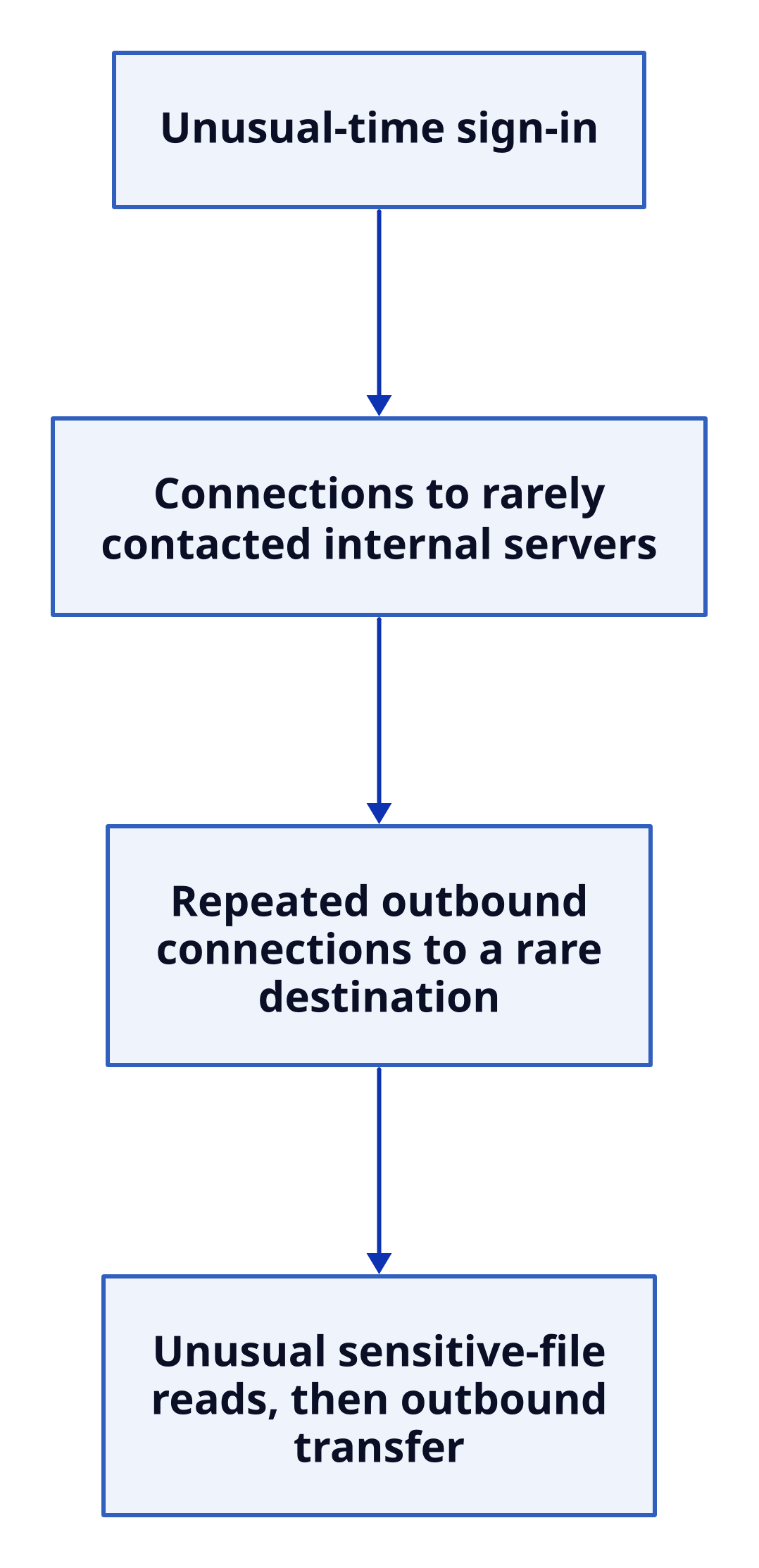
A stronger assessment comes from connecting events over time instead of treating one alert as proof. Consider the source’s example: an account signs in to a workstation at an unusual time; that workstation contacts several internal servers it rarely reaches; it makes repeated outbound connections to a rare destination; and file-access records show unusual reads of sensitive material followed by an outbound transfer.
Together, these observations may indicate a progression from account misuse to , C2, and possible . The sequence is a reason to investigate, not confirmation that each activity occurred.
Text description
A possible sequence of related observations A downward four-step sequence: an unusual-time sign-in to a workstation; connections from it to rarely contacted internal servers; repeated outbound connections to a rare destination; and unusual sensitive-file reads followed by an outbound transfer. Layout: down. Unusual-time sign-in Connections to rarely contacted internal servers Repeated outbound connections to a rare destination Unusual sensitive-file reads, then outbound transfer Unusual-time sign-in → Connections to rarely contacted internal servers Connections to rarely contacted internal servers → Repeated outbound connections to a rare destination Repeated outbound connections to a rare destination → Unusual sensitive-file reads, then outbound transfer
Verify before concluding
Check timestamps, host and user identities, destination details, and established baselines to confirm that the events belong together and are unusual for the systems involved. Compare activity with normal traffic patterns as well as known indicators, and investigate results to reduce false positives. Even a coherent sequence can have benign explanations; validate the evidence before drawing conclusions or treating a suspected progression as established.
: Connecting security events over time to assess whether they form a meaningful pattern.