

Information Systems at Work
How people, processes, data, and technology combine to produce useful information for organizational work.
How Information Systems Support Work
More than computers
An (IS) is an organized set of people, , , and technology that collects, , stores, and shares information to support an organization’s work. Its purpose is not simply to run computers: it helps people perform tasks, coordinate activities, and make decisions.
The four components work together:
People use, manage, design, and maintain the system. Their roles, skills, and decisions affect whether it fits organizational needs.
guide the work: they specify how tasks are performed, who is responsible, and when information is captured or acted on. In this model, procedures are part of ; some other models treat procedures as a separate component.
are recorded facts. Organized and interpreted in context, they can become useful information. For instance, a sales total can indicate which products are in greatest demand.
Technology—hardware, software, and communications tools—enables to be captured, processed, stored, and transmitted. Technology alone does not determine what information is needed or how people should use it.
The relationship is interdependent: people follow and use technology to work with . The resulting information then helps people carry out or adjust their work. If are inaccurate, unclear, technology unsuitable, or users insufficiently trained, the information the organization receives can be undermined.
Following information through an online order
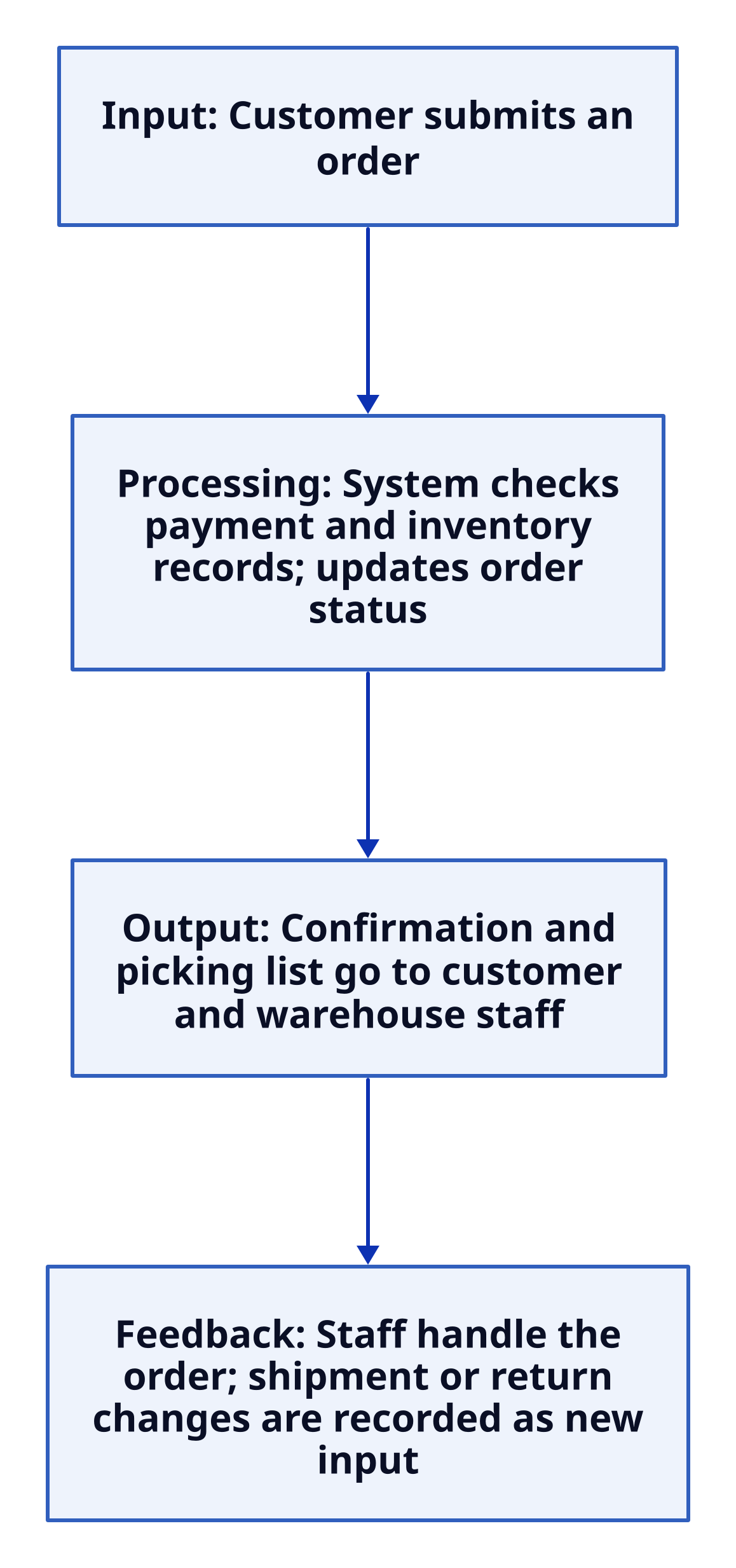
A basic information flow has four stages. The online-store example shows how they connect: a customer submits an order; the system checks payment and inventory records and updates order status; it sends a confirmation and a picking list to the customer and warehouse staff; then staff handle the order, and events such as shipment or return are recorded. Those updates provide feedback and new input to the system.
Feedback matters because an output is not just an endpoint: people can act on it, and their actions or decisions can produce that the system uses next.
Supporting organizational work
Information systems can support routine transactions, coordination between teams, recordkeeping, and planning. A completed sale, for example, records a transaction, helps warehouse staff monitor stock, and contributes to sales summaries managers use for planning. Thus, the same can support several kinds of work.
Useful results depend on the components fitting both the work and the people doing it. An is effective not just because technology is present, but because people, , , and technology work together to produce information that people can use.
Text description
Information flow in an online order Four vertically arranged process boxes linked by downward arrows: Input—customer submits an order; Processing—the system checks payment and inventory records and updates order status; Output—a confirmation and picking list go to the customer and warehouse staff; Feedback—staff handle the order, and shipment or return changes are recorded as feedback and new input. Layout: down. Input: Customer submits an order Processing: System checks payment and inventory records; updates order status Output: Confirmation and picking list go to customer and warehouse staff Feedback: Staff handle the order; shipment or return changes are recorded as new input Input: Customer submits an order → Processing: System checks payment and inventory records; updates order status Processing: System checks payment and inventory records; updates order status → Output: Confirmation and picking list go to customer and warehouse staff Output: Confirmation and picking list go to customer and warehouse staff → Feedback: Staff handle the order; shipment or return changes are recorded as new input