

Whole-Life Environmental Assessment of Infrastructure
A concise lesson on assessing infrastructure impacts across the entire system and life cycle using life cycle assessment.
Assess the Whole Infrastructure Life Cycle
Infrastructure’s environmental effects are not confined to the project site or its years of operation. A road, for example, uses energy and materials during construction and maintenance, affects land and ecosystems, and can create pollution throughout its life. Looking only at operations—or only at the site—would leave out parts of the picture. A sound assessment therefore considers both the whole system and the whole life cycle.
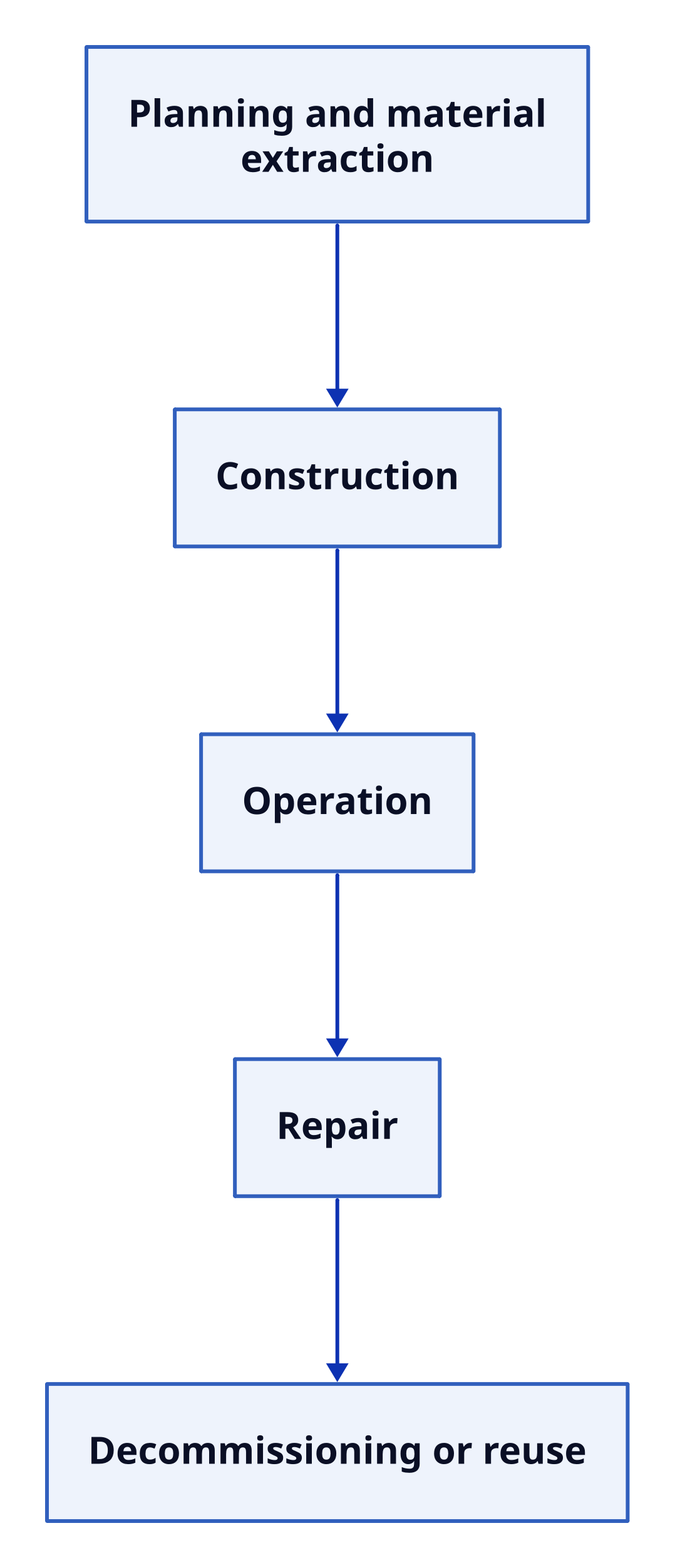
Text description
A whole-life view A downward sequence of five stages: Planning and material extraction, Construction, Operation, Repair, and Decommissioning or reuse. Layout: down. Planning and material extraction Construction Operation Repair Decommissioning or reuse Planning and material extraction → Construction Construction → Operation Operation → Repair Repair → Decommissioning or reuse
organizes this work into four steps: define the study, compile data on resources and emissions, assess potential impacts, and interpret the results. These steps provide a structure for examining the project across its whole life cycle—from planning and material extraction through construction, operation, repair, and decommissioning or reuse—rather than treating a single stage or indicator as the whole assessment.
: Considering infrastructure as a whole and assessing its environmental effects across its life, from planning through decommissioning or reuse.