

Analyzing and Allocating Tort Liability
A structured method for separating underlying tort liability from allocation, collection, and reimbursement among defendants.
From Liability to Allocation and Collection
From liability to allocation
When several people or entities may be connected to an injury, keep two questions separate: who is legally liable to the plaintiff, and how the loss is allocated among liable parties. A relationship between defendants does not itself prove that anyone committed a tort. The governing jurisdiction’s statutes and case law control each stage, so identify the applicable law before drawing conclusions.
Text description
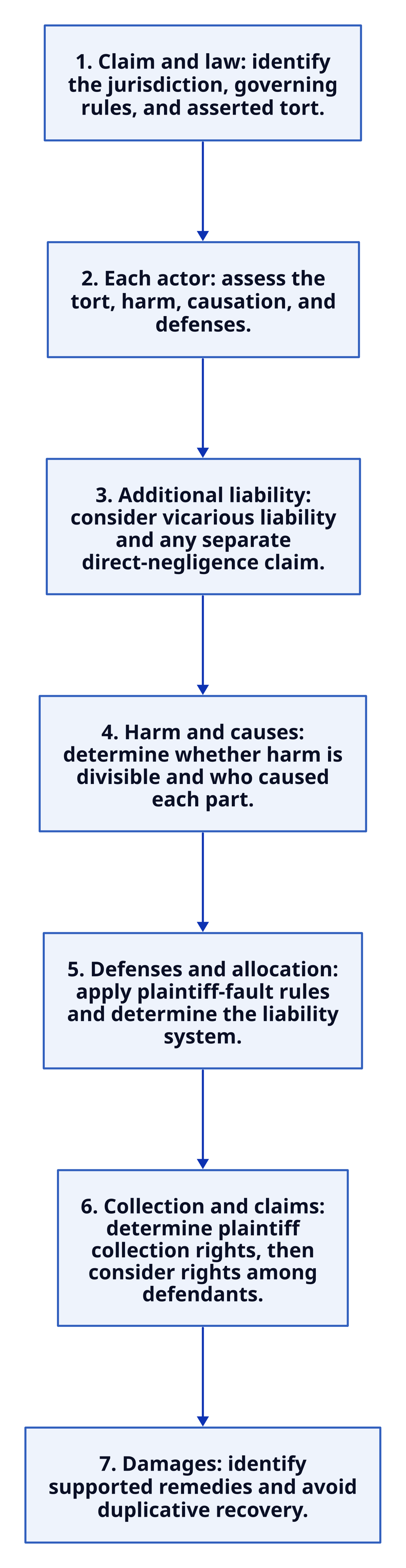
Tort analysis sequence A downward sequence of seven connected stages: identify the claim and governing law; assess each actor’s liability; check additional bases of liability; identify harm and causes; apply defenses and allocation rules; separate collection from defendants’ final allocation; confirm recoverable damages. Layout: down. 1. Claim and law: identify the jurisdiction, governing rules, and asserted tort. 2. Each actor: assess the tort, harm, causation, and defenses. 3. Additional liability: consider vicarious liability and any separate direct-negligence claim. 4. Harm and causes: determine whether harm is divisible and who caused each part. 5. Defenses and allocation: apply plaintiff-fault rules and determine the liability system. 6. Collection and claims: determine plaintiff collection rights, then consider rights among defendants. 7. Damages: identify supported remedies and avoid duplicative recovery. 1. Claim and law: identify the jurisdiction, governing rules, and asserted tort. → 2. Each actor: assess the tort, harm, causation, and defenses. 2. Each actor: assess the tort, harm, causation, and defenses. → 3. Additional liability: consider vicarious liability and any separate direct-negligence claim. 3. Additional liability: consider vicarious liability and any separate direct-negligence claim. → 4. Harm and causes: determine whether harm is divisible and who caused each part. 4. Harm and causes: determine whether harm is divisible and who caused each part. → 5. Defenses and allocation: apply plaintiff-fault rules and determine the liability system. 5. Defenses and allocation: apply plaintiff-fault rules and determine the liability system. → 6. Collection and claims: determine plaintiff collection rights, then consider rights among defendants. 6. Collection and claims: determine plaintiff collection rights, then consider rights among defendants. → 7. Damages: identify supported remedies and avoid duplicative recovery.
Apply the steps to multiple defendants
First analyze each actor separately. For negligence, that means examining duty, breach, factual and legal causation, and damages; other torts have their own elements and defenses. Then ask whether an employer or principal may also be liable. Vicarious liability can impose responsibility for another person’s tort because of a legally significant relationship, without requiring proof that the employer was personally negligent. Under respondeat superior, an employer may be liable for an employee’s tort within the scope of employment, while the employee may remain liable too. Scope depends on jurisdiction-specific law and facts; relevant considerations can include the connection to assigned work, time and place, and whether the conduct was at least partly intended to serve the employer. An intentional act is not automatically outside the scope. Separately, an employer may face a direct-liability claim for its own conduct, such as negligent hiring or supervision, if the claim’s elements are established.
Next identify the harm and its causes. Determine whether injury can be divided among causes or is indivisible, and which parties are responsible for each part. Apply plaintiff-fault rules and other defenses before deciding whether liability is several (each defendant is responsible only for an allocated share), joint and several (a defendant covered by the rule may owe the full judgment), or subject to a statutory hybrid. Under joint and several liability, the plaintiff cannot collect more than the total judgment. Multiple defendants do not automatically mean joint and several liability.
Collection is not the same as allocation
Work out what the plaintiff may collect from each defendant under the governing rule. Then consider defendants’ rights against one another, along with settlement effects and collectability. Contribution may let a liable defendant who paid more than an assigned share recover a fair share from another liable party; the allocation method and availability vary. If another liable party cannot pay, the paying defendant may be unable to recover that party’s full share. Indemnity may shift all or part of a loss under an agreement or recognized legal rule. It differs from contribution, which generally divides a shared loss, and is not automatic merely because one defendant paid more.
In the source example, a delivery employee negligently causes a collision while making a work-related delivery. The plaintiff may pursue the employee and, if the conduct was within the scope of employment, the employer under respondeat superior. If another driver contributed to the same injury, the court must also apply local rules on harm and allocation. Any reduction for plaintiff fault, collection from a particular defendant, and later contribution or indemnity are distinct questions. Finally, confirm which damages and remedies are supported and permitted; do not allow duplicative recovery.