

How Conventional Water Treatment Removes Particles
Trace how conventional drinking-water treatment prepares water through successive particle-removal barriers, and distinguish those barriers from disinfection.
A sequence of particle-removal barriers
A chain of complementary barriers
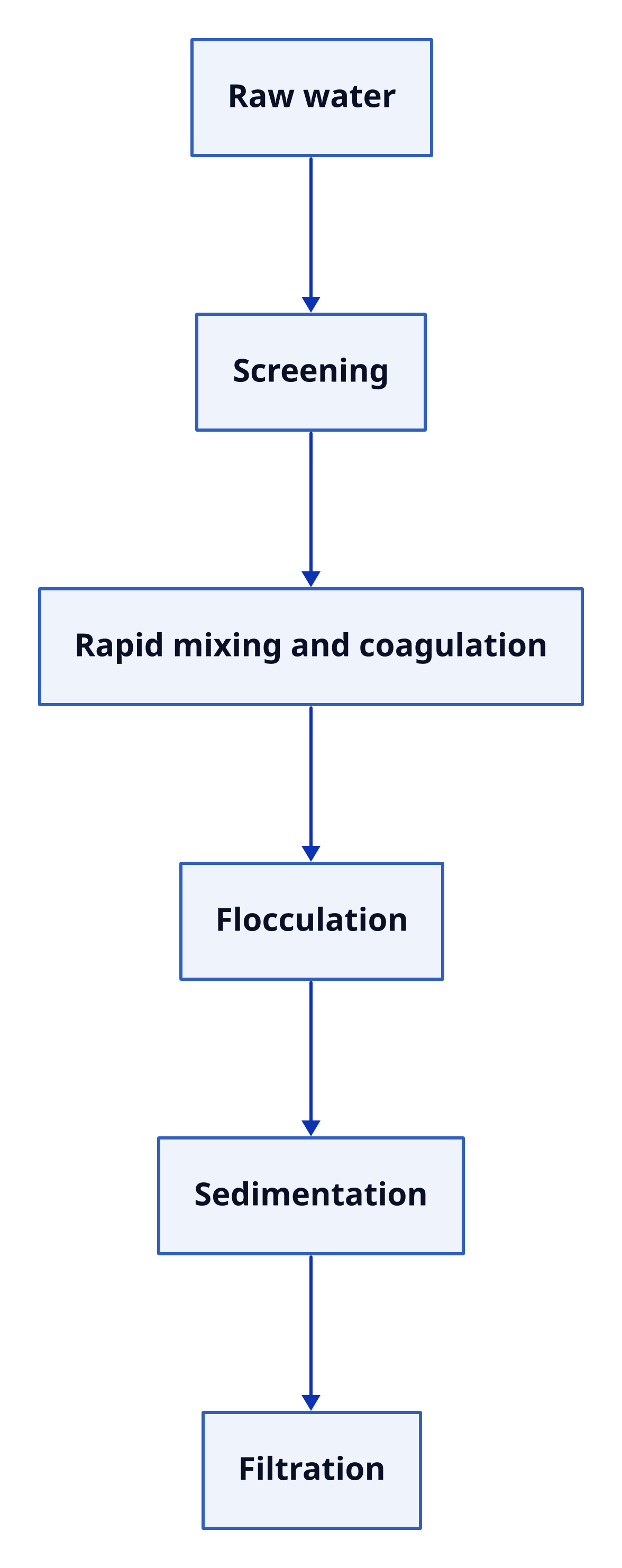
Conventional drinking-water treatment removes suspended material through a sequence: raw water → screening → rapid mixing and coagulation → flocculation → sedimentation → filtration. Each stage makes the next more effective.
Text description
Particle-removal sequence A top-to-bottom chain of six labeled stages, connected in order: Raw water → Screening → Rapid mixing and coagulation → Flocculation → Sedimentation → Filtration. Layout: down. Raw water Screening Rapid mixing and coagulation Flocculation Sedimentation Filtration Raw water → Screening Screening → Rapid mixing and coagulation Rapid mixing and coagulation → Flocculation Flocculation → Sedimentation Sedimentation → Filtration
Why the stages work together
Screens keep sticks, leaves, and other large debris from reaching pumps and later treatment units. Coagulation is different from flocculation: rapid, thorough mixing distributes a measured coagulant dose and destabilizes fine particles; then gentle mixing encourages those particles to form larger, more settleable and filterable clumps called floc. Mixing too vigorously can break floc apart.
For example, clay in muddy water may be too fine to settle quickly by itself. Coagulation and gentle flocculation form larger aggregates, allowing gravity to settle much of the floc in a sedimentation basin. The settled solids form sludge for removal. Filtration then passes clarified water through porous material, commonly sand and other granular media, to capture particles that escape settling. It adds another barrier, but is not a general method for removing dissolved contaminants.
The exact process depends on the source water and plant design. Some approaches, such as direct filtration, may omit sedimentation. Particle-removal steps can help remove microbes, but they do not replace disinfection, which remains a separate, essential treatment step.