

Planning Audit Evidence
A practical framework for translating an audit question into criteria, evidence, and procedures that test the claim.
Plan Evidence from the Audit Objective
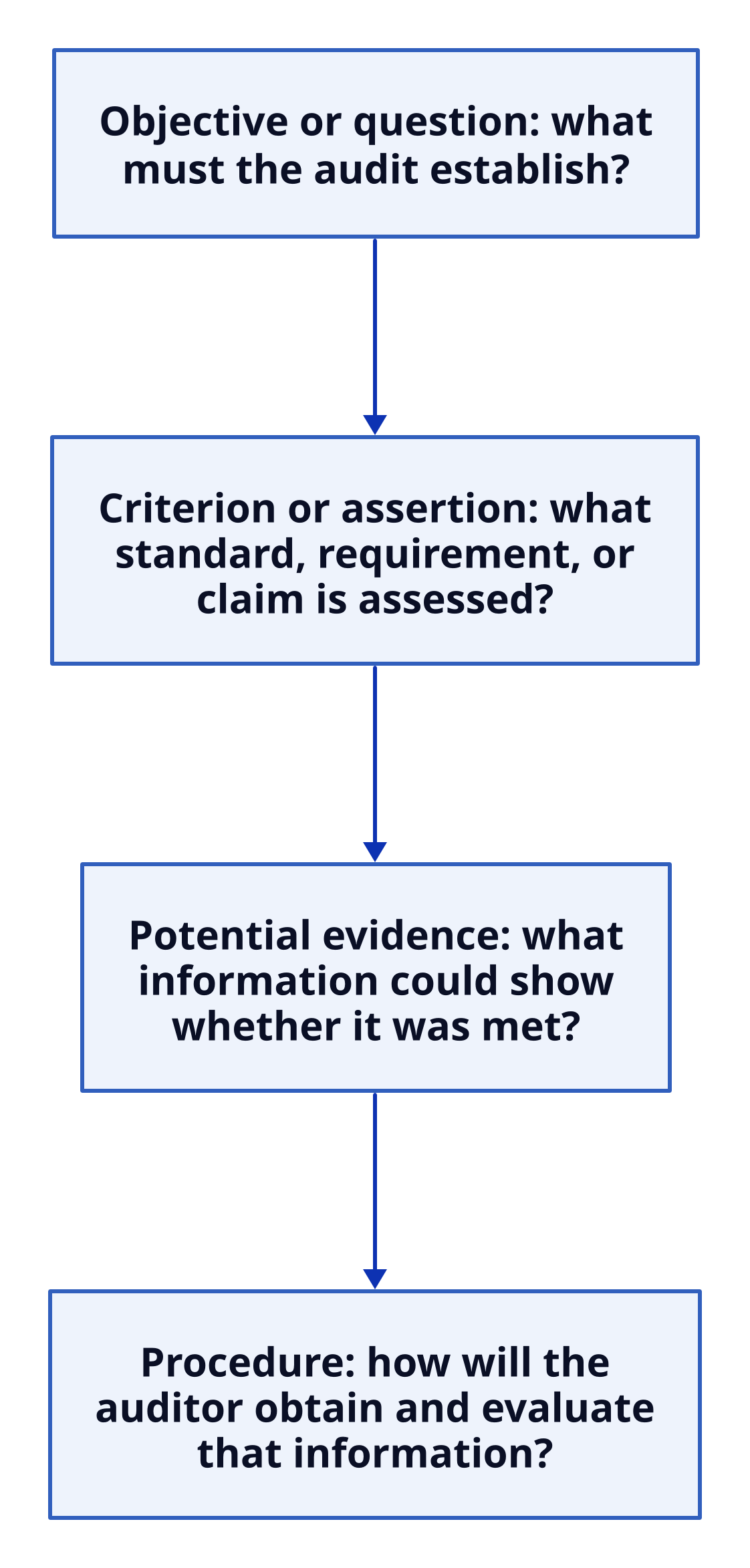
Text description
Planning chain A downward flowchart with four boxes connected in order: Objective or question—state what the audit must establish; Criterion or assertion—identify the standard, requirement, or claim being assessed; Potential evidence—determine what information could show whether the criterion was met; Procedure—choose how to obtain and evaluate that information. Layout: down. Objective or question: what must the audit establish? Criterion or assertion: what standard, requirement, or claim is assessed? Potential evidence: what information could show whether it was met? Procedure: how will the auditor obtain and evaluate that information? Objective or question: what must the audit establish? → Criterion or assertion: what standard, requirement, or claim is assessed? Criterion or assertion: what standard, requirement, or claim is assessed? → Potential evidence: what information could show whether it was met? Potential evidence: what information could show whether it was met? → Procedure: how will the auditor obtain and evaluate that information?
Start with the claim
Audit evidence is information used to evaluate an objective, support findings, and reach conclusions. It may support or contradict an assertion or expectation. Planning therefore starts with the question the audit must answer—not simply with whatever documents are readily available.
Work backward: state the objective, identify the relevant criterion or assertion, ask what information could show whether it was met, and then choose a procedure to obtain and evaluate that information. The procedure must test the specific claim, for the right period and population. Evidence can be collected correctly yet still be irrelevant if the test addresses a different claim.
Procedure direction matters
Consider testing whether reported deliveries were made. Starting with recorded deliveries and tracing a sample to signed receiving records, shipping documents, or recipient confirmations checks whether those recorded items occurred. But if the question is whether all deliveries were recorded, begin with source shipping records and trace them into the accounting records. That direction is suited to testing completeness: it can reveal source items missing from the records. Reversing the starting point changes what the test can establish.
Worked planning example: expense approvals
Suppose the objective is to determine whether expenses above a policy threshold were approved before payment. Before selecting items, specify the threshold, the period, the population of transactions, and what counts as approval before payment. These choices make the claim testable and clarify which items and dates matter.
Then inspect a sample of paid expenses above the threshold for approval evidence and compare the approval dates with the payment dates. The inspection addresses whether approval evidence exists; the date comparison addresses whether it came before payment. The transaction listing used to select the sample may itself need to be checked for completeness and accuracy. Asking staff how approvals work can explain the process or help identify exceptions, but inquiry alone does not establish that approvals actually occurred.
The conclusion should stay within what the objective, procedure, and evidence support. Applicable evidence requirements depend on the auditing standards and engagement type.