

Soil Remediation: Choosing and Comparing Approaches
A practical guide to selecting, applying, and verifying soil remediation methods based on contaminants, site conditions, and cleanup objectives.
Choosing a Remedy and Removing Soil
Choosing a remedy
A remedy should fit the site, not just the contaminant. Selection depends on contaminant types and concentrations, where they are located, soil and groundwater conditions, nearby receptors, site access, cleanup goals, and available time. is essential: a treatment must reach the contamination, and sampling and monitoring are needed to check its performance. The objective is to protect human health and the environment according to site-specific cleanup goals.
Remedies work in different ways. Some remove or treat contamination; others manage exposure or limit movement while contamination remains. is a direct removal option, especially when concentrated contamination is accessible, in-place treatment is unsuitable, or a source poses an urgent risk.
: removal and verification
removes contaminated soil for treatment above ground or disposal at an authorized facility. Cleanup verification is part of the work: samples from the ’s bottom and sides help determine whether cleanup levels have been met. Dust, vapor, runoff, stockpiles, and truck traffic also need appropriate controls.
can remove accessible contamination quickly, but access and handling can limit its use. Work beneath buildings or utilities, or below the water table, can be difficult or disruptive; deep may require shoring, dewatering, and substantial material handling. Removing contaminated soil does not by itself address contamination that has already reached groundwater. So the choice is not simply “dig or do not dig”: it depends on site conditions, cleanup objectives, and what contamination remains beyond the .
: Isolating Contamination
: isolating contamination
limits contact with contaminated soil or its movement; it does not remove or destroy the contaminants. A surface —such as designed soil, clay, a geomembrane, asphalt, or concrete—can reduce direct contact, erosion, and water infiltration. Underground barriers such as slurry walls can limit groundwater movement around a contaminated area. Caps and barriers may be combined, sometimes with pumping or treatment of groundwater inside the enclosed area.
can be useful when a large volume of soil makes removal impractical. Its protection, however, depends on maintaining controls over contamination left in place. The must remain intact, and barriers and caps need inspection, maintenance, and monitoring. Future land use and also need controls: for example, if work goes through a , it must be managed to avoid exposing or spreading contaminated soil. therefore reduces risk only while the isolation and stewardship measures continue to work.
Treating Soil Underground
Treating soil underground
acts on contaminated soil underground without removing most of it. The method can involve injecting reagents to transform contaminants, supporting conditions for biodegradation, heating soil to mobilize contaminants for recovery, or mixing binders into soil to reduce contaminant mobility. These approaches do not all do the same thing: some destroy or remove contaminants, while others primarily immobilize them.
Treating soil in place can address deep contamination or areas beneath structures with less and disruption. But the treatment must reach the contaminated zones, and any resulting products must be recovered or controlled. Heterogeneous or low-permeability soils can make delivery uneven, and treatment may take longer than . Site-specific testing and monitoring help establish whether the chosen process reaches its goals; the method’s name alone does not demonstrate that cleanup has succeeded.
Soil Vapor Extraction and Integrated Remedies
Soil vapor extraction
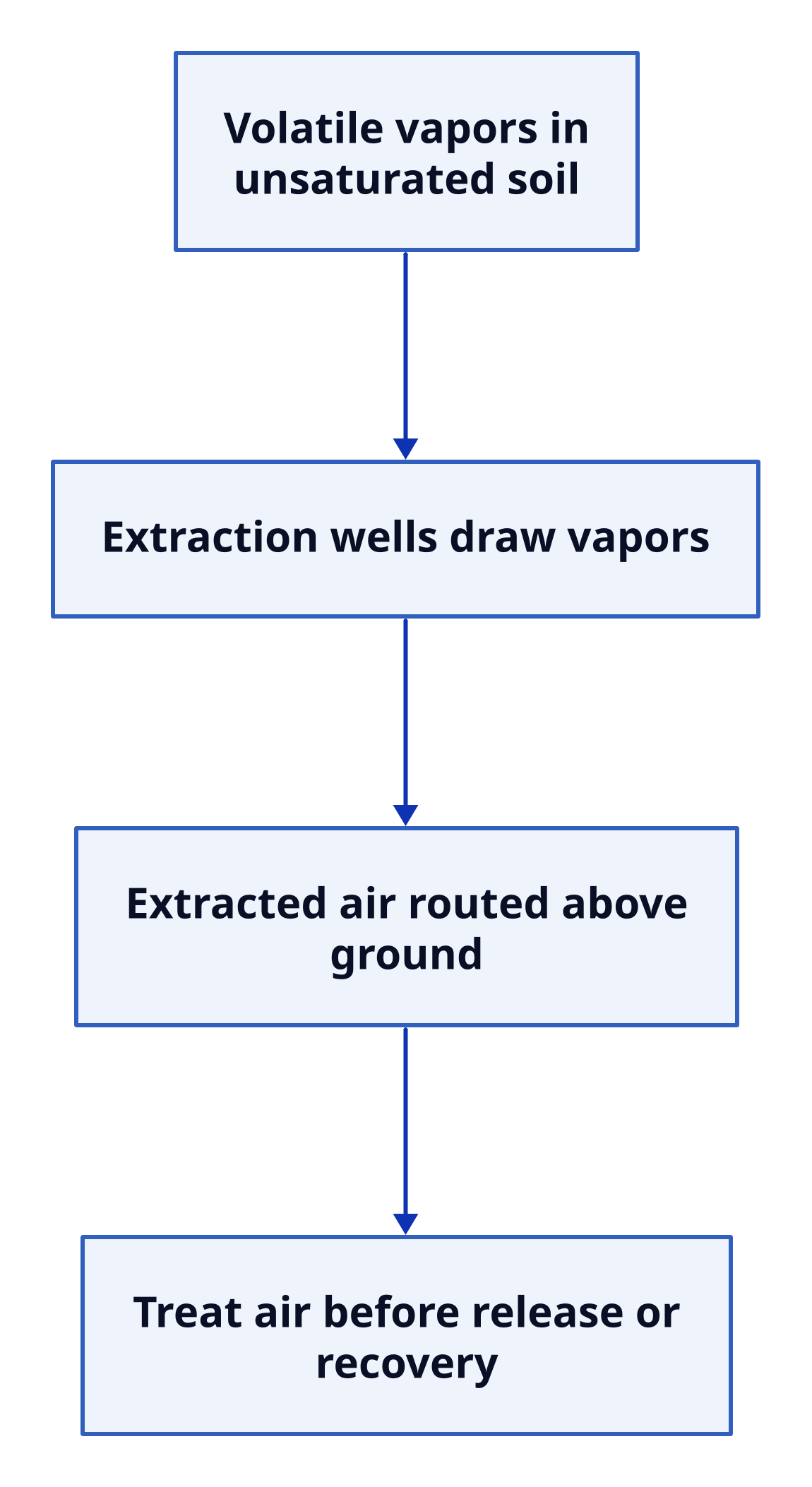
is an in situ method for volatile contaminants, especially volatile organic compounds (), in the —the soil above the water table. A blower or vacuum pump draws air and contaminant vapors through extraction wells. The extracted air is routed to aboveground treatment, such as activated-carbon adsorption or another approved process, before discharge or recovery. Monitoring points and a surface cover may help limit clean air from short-circuiting through the system or vapors from escaping uncontrolled.
Text description
SVE pathway A top-to-bottom flowchart connects four steps with arrows: volatile vapors in unsaturated soil; extraction wells drawing vapors; extracted air routed above ground; and air treatment before release or recovery. Layout: down. Volatile vapors in unsaturated soil Extraction wells draw vapors Extracted air routed above ground Treat air before release or recovery Volatile vapors in unsaturated soil → Extraction wells draw vapors Extraction wells draw vapors → Extracted air routed above ground Extracted air routed above ground → Treat air before release or recovery
Matching methods to site conditions
SVE is generally most applicable when contaminants readily transfer to vapor and air can move through the soil. Dense, wet, fine-grained soil can restrict airflow and slow cleanup. SVE alone does not directly treat contaminants below the water table. When appropriate, air sparging can complement it: injected air below the water table helps volatilize contaminants, and SVE captures vapors in the soil above it. Extracted vapors still require treatment, and the system needs monitoring to confirm performance.
A remedy can combine approaches to address different parts of a site. One source example is excavating a highly contaminated hotspot, treating residual with SVE, and capping soil that remains. This combines removal, treatment, and rather than expecting a single method to handle every condition. should identify contaminants, concentrations and locations, soil and groundwater conditions, nearby receptors, access constraints, cleanup goals, and available time. Sampling and monitoring then help verify that treatment reaches its site-specific objectives and protects human health and the environment. Monitoring and long-term stewardship may be necessary, especially when contamination remains in place.
: A set of approaches used to reduce risks from soil contamination.
: Reducing the ability of contaminants to move through the soil.