

Designing Compliance Monitoring
A practical framework for turning applicable legal and permit requirements into assigned, scheduled checks that verify actual compliance.
Start with the Obligations
What monitoring is for
is the planned collection and review of information to determine whether an organization is meeting its obligations. It can involve self-checks, instrument readings, sampling and analysis, inspections, operating-log reviews, internal audits, and regulator inspections or record reviews. The purpose is not simply to produce data: monitoring should help establish whether the relevant requirement is being met.
Build the register from the actual requirements
Start an by identifying each requirement’s source and exact terms—for example, a permit condition or regulation. Then record what activity, equipment, location, or process it applies to; what must be measured, inspected, tested, or otherwise verified; and how often. Include the responsible role and any required qualifications, applicable limits and deadlines, notification triggers and reporting channels, and the records to create and how long to retain them.
These details make a requirement usable: they clarify what a check must examine, who is expected to do it, and what evidence should remain. Do not treat a sample schedule or limit as universal. The controlling laws, regulations, permits, orders, and jurisdiction determine the applicable duties, frequencies, deadlines, reporting methods, and records.
| Register entry | What it identifies |
|---|---|
| Source and exact terms | Where the obligation comes from and what it requires |
| Scope | Activity, equipment, location, or process covered |
| Check | What to verify and how often |
| Responsibility | Role responsible and required qualifications |
| Limits and reporting | Limits, deadlines, triggers, and channels |
| Records | Evidence to create and retention period |
Schedule Checks That Verify Compliance
Turn register entries into planned checks
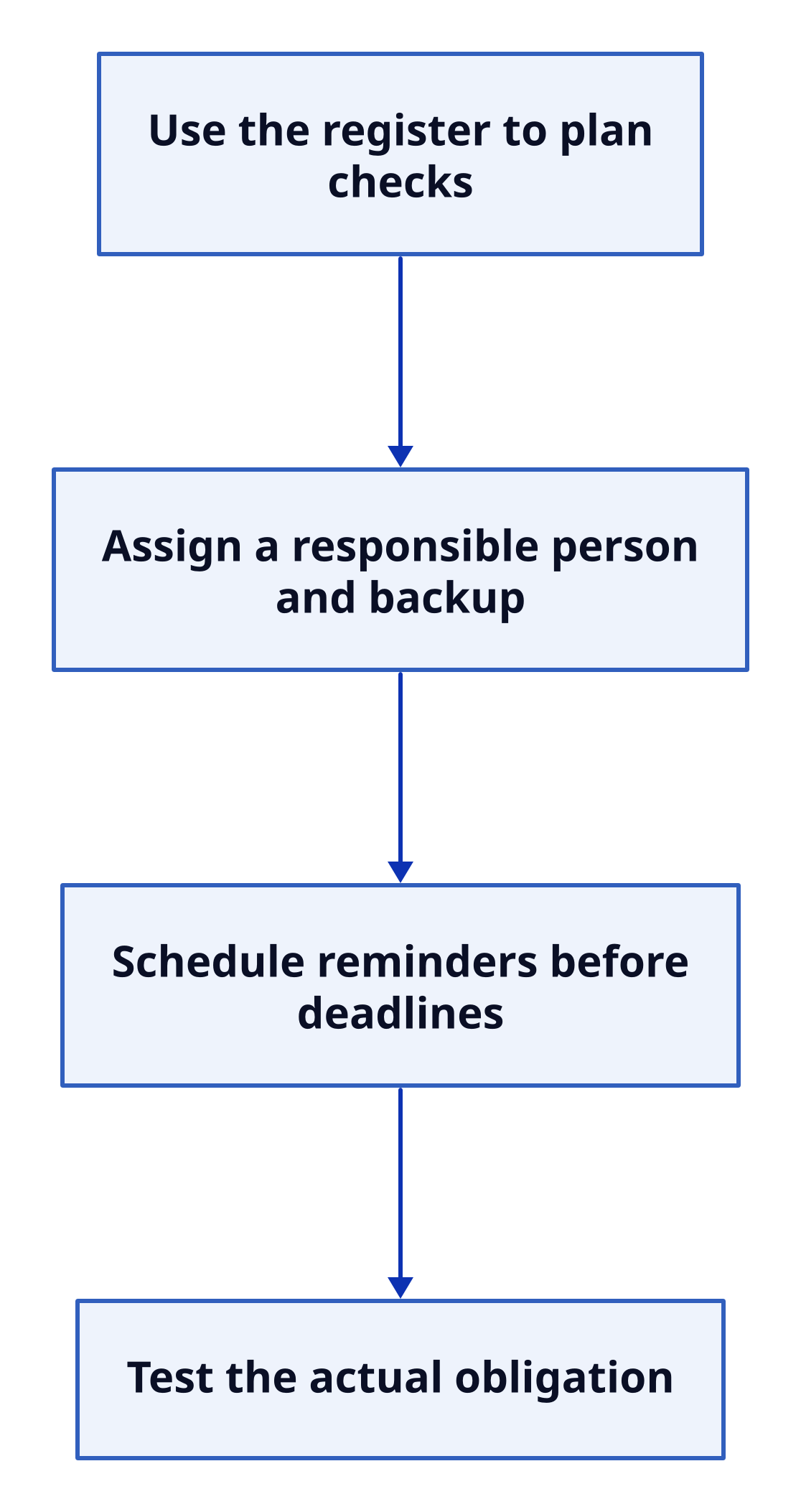
Once the is complete, translate its entries into a calendar, checklist, or workflow. For each check, assign a responsible person and a backup. Schedule reminders early enough to complete the check and review its results before any applicable deadline. This connects the requirement to an owner, a planned action, and time for review.
The check must test the obligation itself—not just confirm that someone performed an activity. If a requirement sets a limit for a measurement, for example, recording that the measurement took place is only part of the job. The result must also be compared with the applicable limit.
Work through the permit example
The source describes a facility whose permit requires a monthly reading and a quarterly report. The facility schedules the readings and records their dates and the instruments used. It then checks the results against the permit limit and assigns a reviewer to verify the quarterly report before submission. Each step has a distinct purpose: scheduling supports timely completion; recording dates and instruments helps document what was done; comparing results tests the requirement; and review checks the report before it is submitted.
The permit—not this example—sets the actual frequency, limits, and reporting rules. A sound monitoring plan therefore starts with the applicable obligation and builds checks and review steps around its terms.
Text description
From obligation to verification A four-step sequence runs downward: translate register entries into a calendar, checklist, or workflow; assign a responsible person and a backup; schedule reminders early enough for review before deadlines; then verify the actual obligation, such as comparing a measurement with its applicable limit. Layout: down. Use the register to plan checks Assign a responsible person and backup Schedule reminders before deadlines Test the actual obligation Use the register to plan checks → Assign a responsible person and backup Assign a responsible person and backup → Schedule reminders before deadlines Schedule reminders before deadlines → Test the actual obligation
: A planned check that examines whether a specific applicable obligation is being met.