

Selecting and Verifying Pollution Controls
A practical lesson on comparing pollution-prevention and treatment options, accounting for performance, costs, residuals, permit requirements, and ongoing verification.
Evaluate the Whole Control System
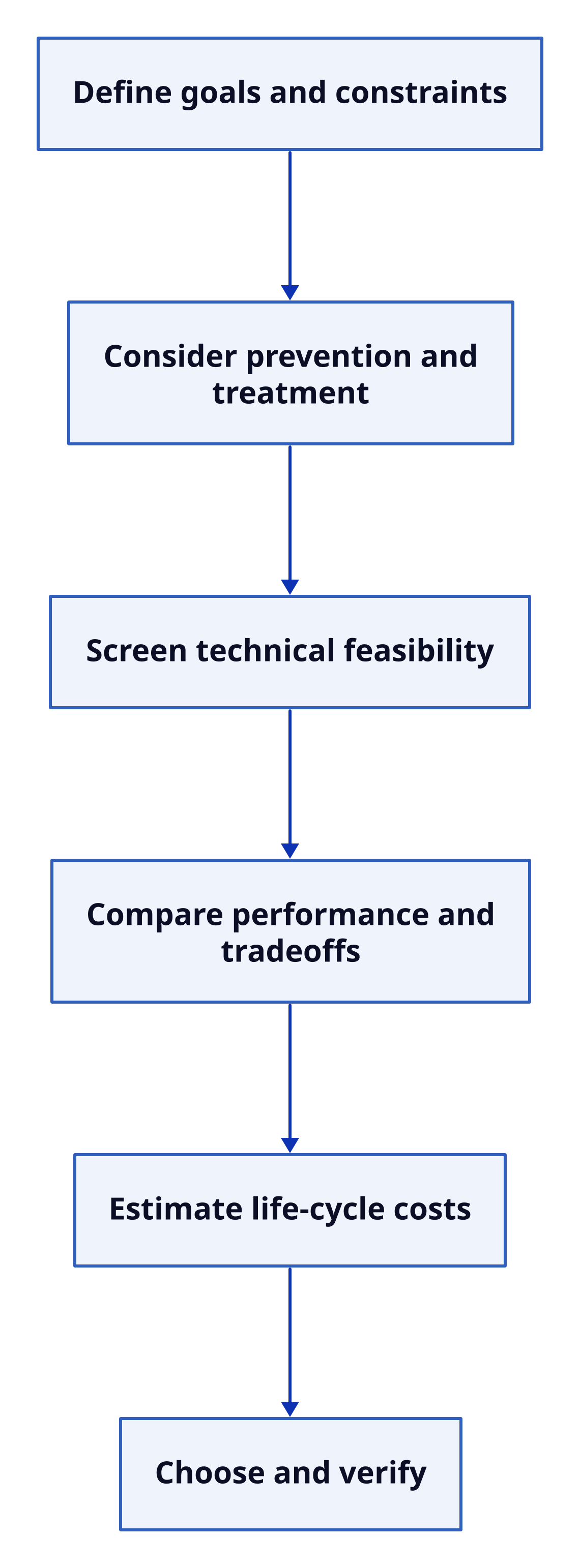
Choose a control system in stages
A pollution-control choice is not simply a contest between devices’ performance figures. Start by defining the pollutants, source conditions, required limits, and applicable permit obligations. These constraints establish what a candidate system must achieve. For covered wastewater discharges, can also set how and where compliance is monitored and reported; requirements depend on the actual permit and discharge.
Next, consider prevention as well as treatment: source reduction, process changes, reuse or recovery, and end-of-pipe controls may all be options. Screen candidates for technical feasibility at the particular site, considering the pollutant, stream, scale, and operating conditions. Then compare the mass of pollution reduced and the system’s reliability alongside its resource needs, residuals, and effects on other environmental media. A control that captures pollution in one form may leave residuals that also need consideration.
Estimate life-cycle costs using consistent assumptions. Include capital, operating, maintenance, monitoring, and residuals costs—not just the purchase price. Finally, select an option that meets applicable requirements and can perform reliably, then establish monitoring and maintenance procedures to check that it continues to do so.
Worked comparison: Suppose a facility is considering a fabric filter and a wet scrubber for particulate control. Rather than choosing from a single performance figure, assess expected particulate emissions under the facility’s actual exhaust conditions, energy and water needs, and maintenance. Include the filter’s collected dust and the scrubber’s wastewater or sludge in the comparison. The preferred system depends on the required limit, site conditions, total costs, and ; the comparison alone does not establish a universal winner.
Text description
A staged evaluation A downward flowchart connects six stages in order: Define goals and constraints; Consider prevention and treatment; Screen technical feasibility; Compare performance and tradeoffs; Estimate life-cycle costs; Choose and verify. Layout: down. Define goals and constraints Consider prevention and treatment Screen technical feasibility Compare performance and tradeoffs Estimate life-cycle costs Choose and verify Define goals and constraints → Consider prevention and treatment Consider prevention and treatment → Screen technical feasibility Screen technical feasibility → Compare performance and tradeoffs Compare performance and tradeoffs → Estimate life-cycle costs Estimate life-cycle costs → Choose and verify
: Evaluating a pollution-control approach as a complete system, including prevention, treatment, tradeoffs, costs, and ongoing verification.