

Structural Stability and Strength
Explains how structural stability differs from strength and what allows a structure to maintain equilibrium under vertical and lateral loads.
Maintaining Equilibrium
Stability means resisting runaway movement
A structure is stable when it can remain in equilibrium under its loads and small disturbances. A small sideways shift is a warning sign if it causes forces that push the structure even farther from its original position. Stability depends on more than the strength of the materials: geometry, supports, connections, stiffness, and a continuous load path all matter.
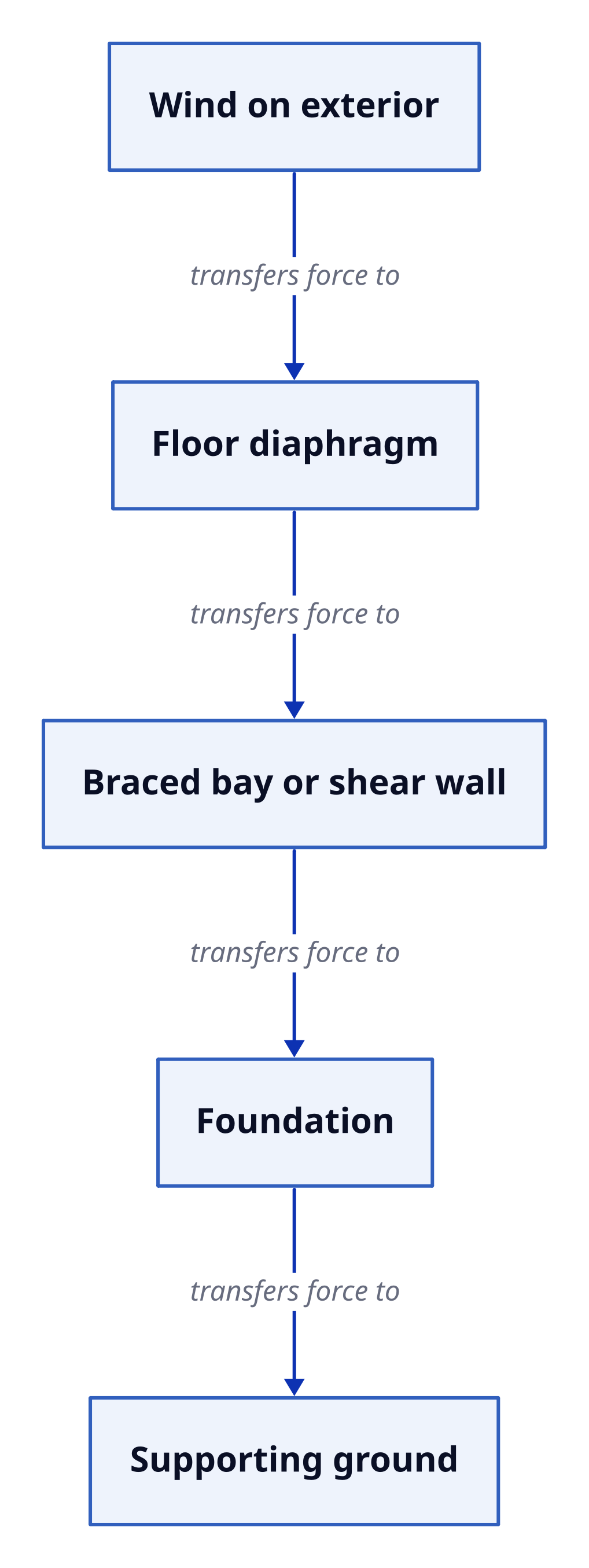
Structures must resist vertical loads, such as their own weight and occupants, and lateral loads, such as wind or earthquake forces. A load path is the route by which a force passes through structural members and connections to the foundations and supporting ground. The example below traces one route for wind force.
Text description
A lateral load path A downward sequence: wind on the exterior transfers force to a floor diaphragm, then to a braced bay or shear wall, then to a foundation, and finally to the supporting ground. Layout: down. Wind on exterior Floor diaphragm Braced bay or shear wall Foundation Supporting ground Wind on exterior → Floor diaphragm (transfers force to) Floor diaphragm → Braced bay or shear wall (transfers force to) Braced bay or shear wall → Foundation (transfers force to) Foundation → Supporting ground (transfers force to)
For example, a building’s floors can collect wind forces and transfer them to braced bays or shear walls, which carry them toward the foundation. If a connection in that route is missing, apparent bracing may not provide a complete load path. The building could sway excessively or become unstable even if its individual beams and columns are strong enough for their local forces. Bracing and connections must be strong and stiff enough to provide their intended restraint. Stability also matters during construction, when a frame may be vulnerable before its permanent floors, walls, or braces are connected.
Strength is the capacity to resist specified forces without exceeding a limit such as yielding, fracture, or crushing. Stability is the ability to maintain equilibrium without uncontrolled movement or buckling. They are distinct but related: buckling can limit a member’s usable strength. A slender column, for instance, may bow under compression before its material crushes or yields. Strong materials and large members alone do not ensure safety if the structure lacks stable geometry, adequate supports, bracing, or connections.