

Structural Systems and Load Paths
A lesson on structural systems and how gravity and lateral forces travel through connected building elements to the ground.
Structural Systems: Walls and Frames
Structural Systems: Walls and Frames
A is the arrangement of structural elements and their connections. In , walls support floors or roofs. In , beams and columns form the main supporting skeleton. These distinctions help identify which elements receive and carry a building’s forces. The particular elements and connections in a system determine how those forces can travel through the building.
Tracing Loads to the Ground
Tracing Loads to the Ground
A is the route a force follows through connected structural elements to the ground. For a building to carry its loads, the elements, connections, and foundation must form a continuous route. Start where the force acts, then ask at each step: What receives the force next, where does that element deliver it, and what connection transfers the force? Continue tracing until the force reaches the foundation and supporting soil.
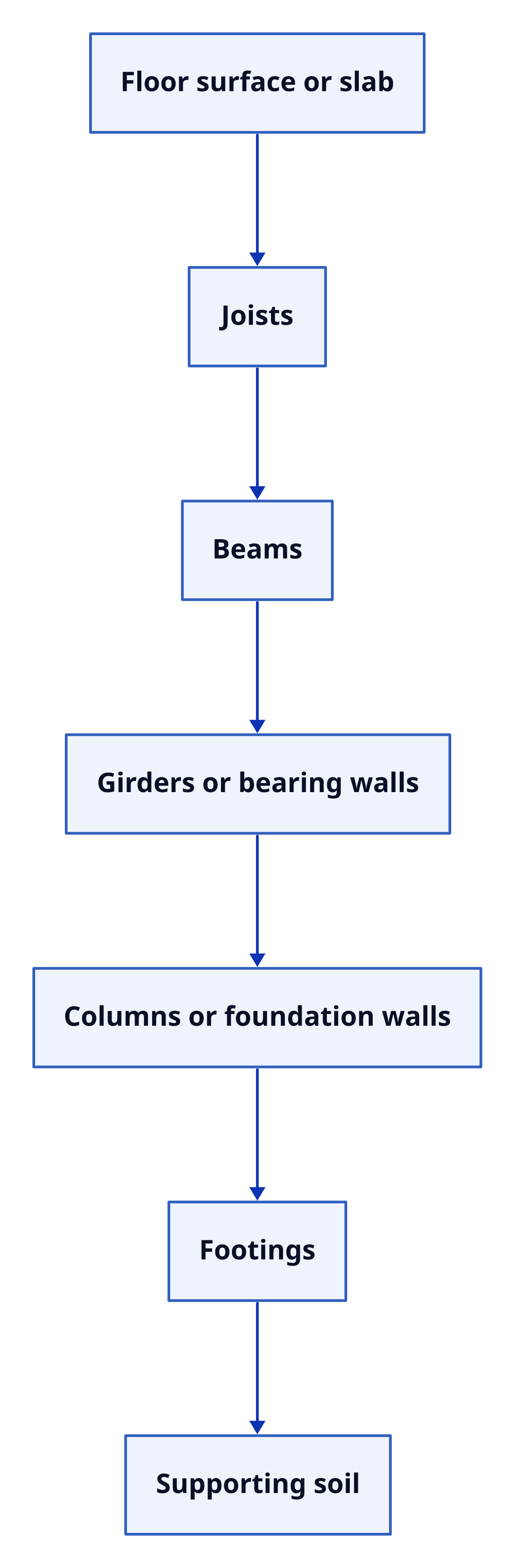
Text description
Typical Gravity-Load Path A downward sequence from Floor surface or slab, through Joists, Beams, Girders or bearing walls, Columns or foundation walls, and Footings, to Supporting soil. Layout: down. Floor surface or slab Joists Beams Girders or bearing walls Columns or foundation walls Footings Supporting soil Floor surface or slab → Joists Joists → Beams Beams → Girders or bearing walls Girders or bearing walls → Columns or foundation walls Columns or foundation walls → Footings Footings → Supporting soil
Gravity loads act mainly downward. Dead loads include the structure’s weight and fixed equipment; live loads include people and movable contents; environmental loads can include snow. The sequence shown is typical, not universal: a slab may bear directly on walls, for example, or roof trusses may transfer loads directly to bearing walls. Thus, trace the actual supports in the building rather than assuming every route contains the same members.
Gravity and lateral loads can also follow different routes. Wind and earthquake forces are lateral. Roofs and floors can act as horizontal diaphragms, collecting and distributing those forces to vertical resisting elements such as shear walls or braced or moment frames. Those elements carry the forces onward to the foundation and soil.
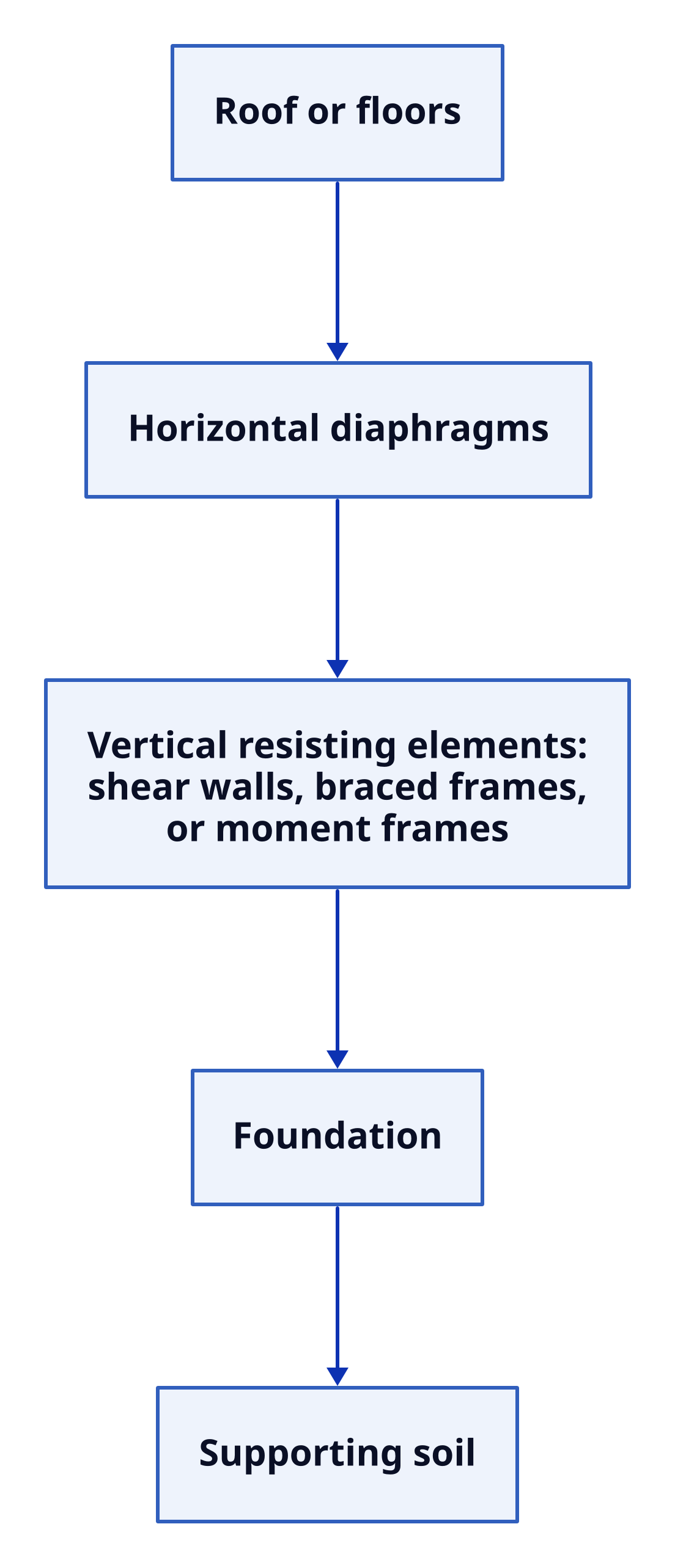
Text description
Typical Lateral-Load Path A downward sequence from Roof or floors, through Horizontal diaphragms and Vertical resisting elements (shear walls, braced frames, or moment frames), to the Foundation and Supporting soil. Layout: down. Roof or floors Horizontal diaphragms Vertical resisting elements: shear walls, braced frames, or moment frames Foundation Supporting soil Roof or floors → Horizontal diaphragms Horizontal diaphragms → Vertical resisting elements: shear walls, braced frames, or moment frames Vertical resisting elements: shear walls, braced frames, or moment frames → Foundation Foundation → Supporting soil
Connections matter at every transition in either route. A weak or missing connection can interrupt the path even if the connected structural members are strong. Check not only which elements appear to support one another, but also whether their connections transfer the force onward toward the foundation and ground.
: The weight of the structure and its fixed equipment.
: Loads from people and movable contents.
: A roof or floor that collects and distributes lateral forces to vertical resisting elements.