

Developing and Managing a Construction Schedule
A practical guide to turning construction scope into a connected, feasible schedule and maintaining it as a reliable progress reference.
From Scope to Trackable Activities
From scope to trackable activities
A construction schedule turns the defined scope into an executable sequence: it connects what the project must deliver with the activities that produce it, the those activities need, and when the work can occur. The first important distinction is that a WBS describes what the project will produce; it does not, by itself, specify the sequence or dates.
For example, a building WBS might organize deliverables under sitework, foundations, structure, enclosure, and building systems. This breakdown helps preserve a traceable link between the project’s scope and the work planned to complete it.
Next, decompose each deliverable into activities that produce or verify it. For a foundation package, the work might include excavation and subgrade preparation; installing formwork and reinforcing steel; inspecting the reinforcement; placing and curing concrete; and stripping forms and backfilling. These are activities, not merely categories of the finished project. Giving each clear start and finish conditions makes it possible to assign responsibility, estimate its duration, and track its status.
Check that the list covers the planned scope—not just the most visible construction tasks. Inspections, approvals, testing, procurement, mobilization, and handoffs may also need to be represented. Using WBS or codes to connect activities back to deliverables helps identify what each piece of scheduled work supports and whether the planned work is complete.
Sometimes later work cannot yet be defined at the same level of detail as near-term work. In that case, use : plan the work that is ready in detail, then refine future activities as more information becomes available. This preserves useful near-term planning without pretending that uncertain future work is already fully defined.
Estimating Work and
Estimating work and
Estimate an ’s , required , and duration together. A duration is not an isolated number: it depends on the crew, equipment, materials, and facilities assumed, as well as on their availability and the conditions in which the work can proceed.
Consider the formwork example. The work quantity is 120 m², and the assumed crew’s production rate is 40 m² per workday. Divide the quantity by the rate:
So the estimate is three workdays if that crew is available for the and the work area is ready. The arithmetic converts the stated quantity and production rate into an initial duration; it does not establish that the conditions needed to achieve that rate will actually hold.
Before relying on the estimate, consider resource availability, production rates, working calendars, access to the site, weather exposure, and other constraints. Consult the people responsible for performing the work and use relevant historical data where available. Record important assumptions and uncertainty. If inspections, restricted access, or shared equipment limit production, the planned duration may need to change. Resource loading can also expose conflicts—for example, when separate activities require the same crew or equipment at the same time. The three-day calculation is therefore a conditional estimate, not a guaranteed completion time.
Logic, Overlap, and the
Build logic from construction requirements
Once activities are defined and estimated, link them according to the actual requirements of the work. In a precedence network, an arrow represents a . The common finish-to-start (FS) relationship means that a successor cannot start until its predecessor finishes. Other relationships—start-to-start, finish-to-finish, or start-to-finish—may be used when work genuinely overlaps, but should not be used merely to force preferred dates. Document necessary lags and constraints, and avoid activities with missing predecessors or successors unless they are legitimate project starts or finishes.
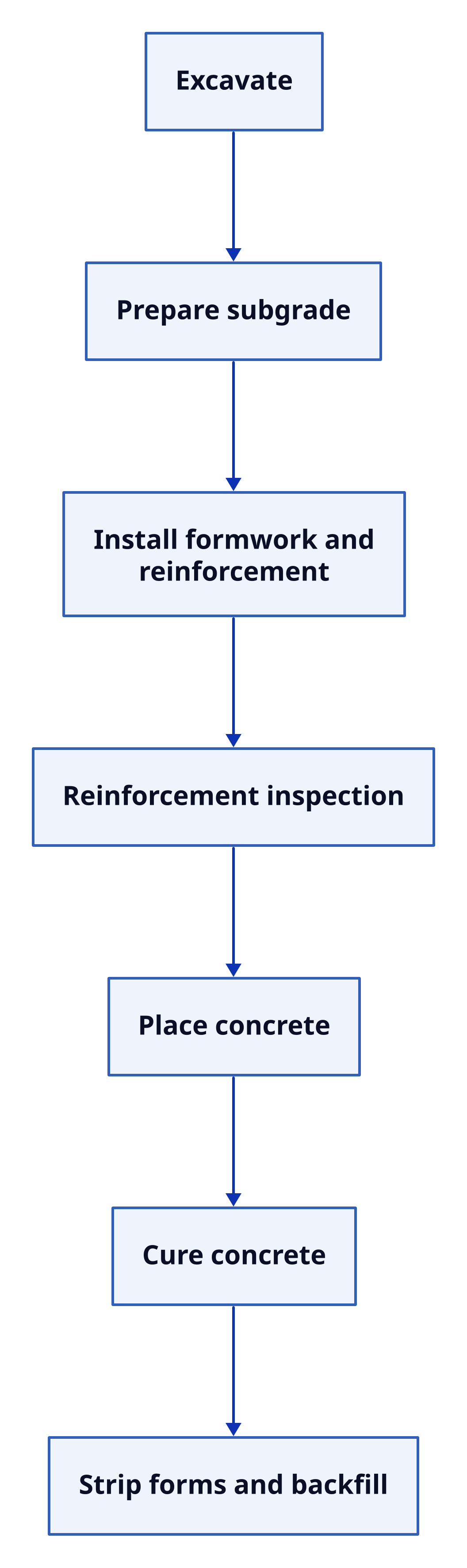
A foundation sequence illustrates how construction requirements shape the network. Excavation and subgrade preparation precede installing formwork and reinforcement; reinforcement inspection precedes concrete placement; placement is followed by curing, then stripping forms and backfilling. The activities are connected because their order reflects the work, not simply because dates have been entered.
Text description
Foundation activity sequence Seven process nodes are arranged vertically with downward arrows: Excavate; Prepare subgrade; Install formwork and reinforcement; Reinforcement inspection; Place concrete; Cure concrete; Strip forms and backfill. Layout: down. Excavate Prepare subgrade Install formwork and reinforcement Reinforcement inspection Place concrete Cure concrete Strip forms and backfill Excavate → Prepare subgrade Prepare subgrade → Install formwork and reinforcement Install formwork and reinforcement → Reinforcement inspection Reinforcement inspection → Place concrete Place concrete → Cure concrete Cure concrete → Strip forms and backfill
Not every must wait for the foundation sequence to finish. Procurement of long-lead equipment, for example, may proceed during foundation work if the design information and approvals needed for procurement are available. This is a conditional opportunity for parallel work, not a reason to omit a real prerequisite.
The planned order must also account for site coordination: access, laydown areas, permits, inspections, and work by other trades can affect whether the sequence is workable. Dependencies should reflect those genuine construction requirements and opportunities for overlap.
Use CPM and carefully
Once the schedule has durations, calendars, and logic, the method (CPM) identifies the longest logic-connected path through it. In the calculated plan, activities on this path have no total , so a delay to one can delay project completion unless the plan changes. Activities with may move within limits without changing the planned completion date.
is flexibility in the calculated schedule—not permission to ignore an . Resource conflicts and site coordination still matter, including for activities with . Review critical and near-critical work with the field team, and check whether the assumptions and constraints behind the plan are credible.
Milestones and the Schedule
Milestones and the schedule
A marks a significant event, rather than a span of work: it has zero duration. Examples include permit approval, foundations accepted, building enclosure complete, permanent power available, and substantial completion. Connect each to the activities that produce it, and set objective completion criteria so the team can determine when it has actually been achieved.
After reviewing scope, logic, durations, calendars, , risks, and key dates, approve the schedule as the . This is the reference plan against which actual progress will be compared. Preserve the approved version and record its assumptions; without that stable reference, it is difficult to tell whether progress matches the plan.
During construction, update actual starts and finishes and forecasts of remaining durations. Investigate variances and use the schedule to identify emerging impacts. Updating the schedule with current information supports monitoring; it is different from changing the itself. Revise the only through the project’s change-control process. Changing the reference plan without control can conceal performance rather than explain what has happened.
In short, milestones make important outcomes visible, while the gives the team a controlled reference for assessing progress and responding to variance.
: A structure that organizes project deliverables into smaller components.